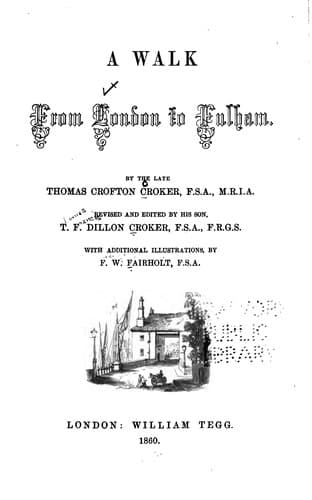
A Walk from London to FulhamCroker, Thomas Crofton
History
A Walk from London to Fulham
Croker, Thomas Crofton
London (England) -- Description and travel
Colman accepted the invitation, believing from the length of Mr. Lowth’s
letter (three pages), and the playfulness of his old friend’s
communication, that nothing more than an ordinary cold was the matter
with him. A note, however, which followed from one of Mr. Lowth’s
daughters, stated that the meeting proposed by her father must be
postponed, that he “had become extremely unwell, that bleeding and
cupping had been prescribed,” and the most perfect quiet enjoined.
On the day after the receipt of this note, Colman sent over to Grove
House, Chiswick, to make inquiries as to Mr. Lowth’s health, when the
reply given by an elderly female at the gate, after considerable delay,
was that “her master was no more.”
A letter from Dr. Badeley to Colman, dated 22d August, 1822, confirmed
the melancholy intelligence, which he had at first hesitated to believe.
It stated that “the decease of Mr. Lowth took place on Sunday evening,”
the very evening appointed by him for their anticipated happy reunion;
and that his remains were to be interred in the family vault at Fulham on
Monday morning at ten o’clock.
“I continued,” said Colman, “at Fulham Lodge, which is nearer in a
direct line to the church than to the Bishop’s Palace and the ‘old
avenue.’ On Monday the adjacent steeple gave early notice of the
approaching funeral; religion and sorrow mingled within me while the
slow and mournful tolling of the bell smote upon my heart. Selfish
feelings, too, though secondary, might now and then obtrude, for they
are implanted in our nature. My departed friend was about my own
age: we had entered the field nearly at the same time; we had fought,
indeed, our chief battles asunder, but in our younger days he had
been my comrade, close to me in the ranks: he had fallen, and my own
turn might speedily follow.”
These are the ideas which George Colman the younger records as having
passed through his mind while an inmate of Fulham Lodge:—
“My walk next morning,” he says, “was to the sepulchre of the Lowths,
to indulge in the mournful satisfaction of viewing the depository of
my poor friend’s remains. It stands in the churchyard, a few paces
from the eastern end of the ancient church at Fulham. The
surrounding earth, trampled by recent footsteps, and a slab of marble
which had been evidently taken out and replaced in the side of the
tomb, too plainly presented traces of those rites, which had been
performed on the previous day. For several mornings I repeated my
walk thither, and no summer has since glided away, except the last,
when my sojournment at Fulham was suspended, without my visiting the
spot and heaving a sigh to the memory of Robert Lowth.”
Theodore Hook’s manuscript Diary contains the following entries with
reference to visits made by him at Fulham Lodge:—
“2nd January, 1826.—Called. Mrs. Carey’s luncheon.
Public-domain text, read in full here on John Shaqi.
Reviews
Reviews
No reviews yet
Be the first to share your thoughts on this work.
Elsewhere in the archive
Join the Discussion
Join the discussion
Sign in to leave a comment or review.
Sign InorCreate an account