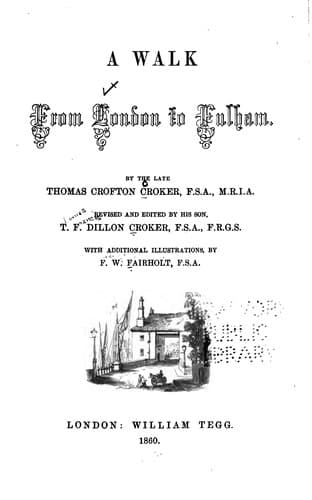
A Walk from London to FulhamCroker, Thomas Crofton
History
A Walk from London to Fulham
Croker, Thomas Crofton
London (England) -- Description and travel
I have already stated that Florio’s house was assessed for the
poor-rate in Fulham Street, on the 12th October, 1625, the year of
Florio’s death; and be it remembered that Florio was the translator
of Montaigne’s Essays, of which a copy of the original edition,
bearing Shakespeare’s very rare autograph, was not very long since
purchased by the British Museum, at what was considered to be a very
large price. When the genuineness of that autograph was keenly
discussed among antiquaries, and the probable date at which the
‘Tempest’ was written, became a question, no one presumed to deny
that the coincidences between the passage in the 2nd Act of the
‘Tempest’ where Gonzalo says—
“I’ the commonwealth I would by contraries
Execute all things; for _no kind of traffic_
Would I admit; _no name of magistrate_;
Letters should not be known: _riches_, _poverty_,
_And use of service_, none: contract, _succession_;
Bourn, bound of land, tilth, vineyard, none;
No use of metal, corn or wine or oil;
No occupation; all men idle, all;
And women too; but innocent and pure:
No Sovereignty:”—
is but an echo of the following in Florio’s translation of
Montaigne:—
—“It is a nation, would I answer Plato, that hath _no kind of
traffic_, no knowledge of letters, no intelligence of numbers, _no
name of magistrate_, nor of politic superiority; no _use of service_,
of _riches_, or of _poverty_; no _contracts_, no _successions_; no
occupation, but idle, no respect of kindred but common; no apparel,
but natural; no manuring of lands, no use of wine, corn, or metal,”
etc.
* * * * *
There are other coincidences also, free from the very great
difficulty of reconciling satisfactorily printed dates with an
imaginary career—which coincidences are too remarkable to have
escaped the host of ingenious commentators upon the supposed sources
of Shakespeare’s information—of his observation what shall I say?
The coincidence between passages in Daniel’s “Civil Warres,”
published in 1595, and passages in Shakespeare’s Richard II., induce
Mr. Charles Knight to observe that “We”—thereby meaning himself—“have
looked at this poem with some care, and we cannot avoid coming to the
conclusion that, with reference to parts of the conduct of the story,
and in a few modes of expression, each of which differs from the
general narrative and the particular language of the chroniclers,
there are similarities betwixt Shakespeare and Daniel which would
lead to the conclusion either that the poem of Daniel was known to
Shakespeare, or the play of Shakespeare was known to Daniel.”
Public-domain text, read in full here on John Shaqi.
Reviews
Reviews
No reviews yet
Be the first to share your thoughts on this work.
Elsewhere in the archive
Join the Discussion
Join the discussion
Sign in to leave a comment or review.
Sign InorCreate an account