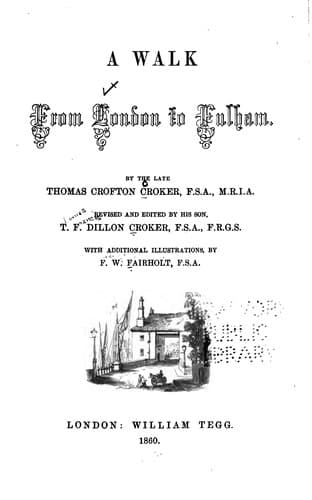
A Walk from London to FulhamCroker, Thomas Crofton
History
A Walk from London to Fulham
Croker, Thomas Crofton
London (England) -- Description and travel
I was wont (for my disport)
Often in the summer season,
To a Village to resort
Famous for the rathe ripe peason,
Where beneath a _Plumb_-tree shade
Many pleasant walks I made.
And Norden, whom we consider as the father of English topography,
dates the address “to all courteous gentlemen,” prefixed to his
account of Middlesex and Hertfordshire, from his “poore home, near
Fulham, 4th November, 1596.”
Here, then, we have a mass of facts, which render it impossible for
us to doubt that the Golden Lion, Fulham, must have been, according
to the custom of the times, frequented by Florio and his
brother-in-law Daniel; by Fletcher; by Henry Condell, Shakespeare’s
fellow-player; by some one of the name of Burbadge; by Joshua
Sylvester, and John Norden, about the years 1595 and 1596. Is there
not, then, every reasonable presumption that our immortal Shakespeare
was also a member of this clique?
[Picture: Fireplaces in the old Golden Lion]
On the pulling down of the Old Inn by Mr. Powell, the panelling was
purchased by Mr. Street, of Brewer Street, and was afterwards sold to
Lord Ellenborough, for the fitting up of his Lordship’s residence,
Southam House, Cheltenham.
Fulham High Street, which extends from the London Road to Church Row,
appears to have been denominated Bear Street, and is called in the more
ancient parish books Fulham Street. The direct approach to Fulham Church
is by Church Row, which branches off to the right of the High Street. On
the left of the churchyard entrance is the Vicarage. The present vicar
is the Rev. R. G. Baker. Opposite the vicarage is a piece of ground,
which was consecrated in 1843 by Bishop Blomfield, who is buried there.
Upon this recent addition to the burial-ground formerly stood Miss
Batsford’s seminary for young gentlemen. There are several curious old
monuments in the church, which have been described and engraved by
Faulkner, to whose work the curious reader may be referred. In the
churchyard are the tombs and monuments of several of the old bishops of
London—Compton, Robinson, Hayter, Gibson, Terrick, Lowth, Sherlock, and
Randolph.
The grave of that distinguished author and brilliant wit, Theodore Hook,
is immediately opposite the chancel window. The stone bears the plain
inscription “Theodore Edward Hook, died 24th August, 1841, in the
fifty-third year of his age.”
[Picture: Old entrance to Pryor’s Bank, 1844] {188b}
Public-domain text, read in full here on John Shaqi.
Reviews
Reviews
No reviews yet
Be the first to share your thoughts on this work.
Elsewhere in the archive
Join the Discussion
Join the discussion
Sign in to leave a comment or review.
Sign InorCreate an account