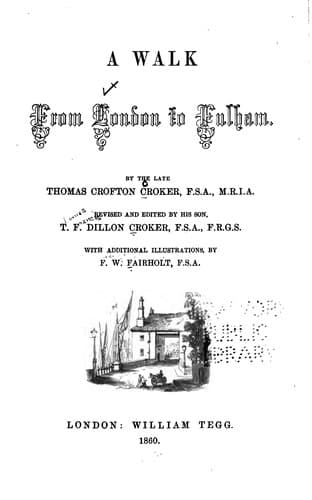
A Walk from London to FulhamCroker, Thomas Crofton
History
A Walk from London to Fulham
Croker, Thomas Crofton
London (England) -- Description and travel
In a print, published about forty years since, by J. Edington, 64
Gracechurch Street, of Fulham Church, as seen from the river, the ancient
aspect of the modern Pryor’s Bank is preserved. [Picture: Fulham Church]
The situation of this humble residence having attracted the fancy of Mr.
Walsh Porter, he purchased it, raised the building by an additional
story, replaced its latticed casements by windows of coloured glass, and
fitted the interior with grotesque embellishments and theatrical
decorations. The entrance hall was called the robber’s cave, for it was
constructed of material made to look like large projecting rocks, with a
winding staircase, and mysterious in-and-out passages. [Picture: Vine
Cottage] One of the bed-rooms was called, not inaptly, the lion’s den.
The dining-room represented, on a small scale, the ruins of Tintern
Abbey; and here Mr. Porter had frequently the honour of receiving and
entertaining George IV., when Prince of Wales. It was then called Vine
Cottage, {213} and having been disposed of by Mr. Porter, became, in
1813, the residence of Lady Hawarden; and, subsequently, of William
Holmes, Esq., M.P., who sold it to Mr. Baylis and Mr. Lechmere Whitmore
about 1834.
By them a luxurious vine which covered the exterior was cut down, and the
cottage, named after it, replaced by a modern antique house. Mr. Baylis
being a zealous antiquary, his good taste induced him to respect
neglected things, when remarkable as works of art, and inspired him and
his friend Mr. Whitmore with the wish to collect and preserve some of the
many fine specimens of ancient manufacture that had found their way into
this country from the Continent, as well as to rescue from destruction
relics of Old England. In the monuments and carvings which had been
removed from dilapidated churches, and in the furniture which had been
turned out of the noble mansions of England—the “Halls” and “old
Places”—Mr. Baylis saw the tangible records of the history of his
country; and, desirous of upholding such memorials, he gleaned a rich
harvest from the lumber of brokers’ shops, and saved from oblivion
articles illustrative of various tastes and periods, that were daily in
the course of macadamisation or of being consumed for firewood.
The materials thus acquired were freely used by him in the construction
of a new building upon the site of Vine Cottage, and adapted with
considerable skill; but when neither the vine nor the cottage were in
existence, it appeared to Mr. Baylis ridiculous to allow a misnomer to
attach itself to the spot. After due deliberation, therefore, respecting
the situation upon a delightful bank of gravel, and the association which
an assemblage of ecclesiastic carvings and objects connected with
“monkish memories,” there collected, were likely to produce upon the
mind, the new house was styled the “Pryor’s Bank.”
Public-domain text, read in full here on John Shaqi.
Reviews
Reviews
No reviews yet
Be the first to share your thoughts on this work.
Elsewhere in the archive
Join the Discussion
Join the discussion
Sign in to leave a comment or review.
Sign InorCreate an account