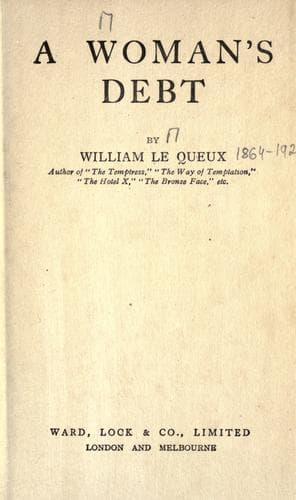
Detective and mystery stories; England -- Social life and customs -- 20th century -- Fiction; English fiction -- 20th century
“You must excuse me, Mr. Morrice, if I am unable to answer that very
natural question. I always like to be as frank as possible with my
clients, but there are times when, from motives perfectly satisfactory
to myself, I am unable to reveal the means by which I obtain our
information.”
Morrice made no reply. He would have dearly loved to know, but he was
fair-minded enough to appreciate the detective’s excuse. Probably he
had obtained his knowledge from some prying servant in the house who
had kept a close watch upon his wife. Lane was not the man to despise
the assistance of any instrument, however humble. Not for one moment
did it occur to Morrice that his niece was implicated in the matter.
“And now, Mr. Morrice, I don’t wish to ask you more than I can help,
for I can fully understand how you must be suffering, and how painful
it must be for you to talk over these things with a stranger. But you
say that my suspicions are confirmed—in short, you have made your
investigations and found what I surmised, that a considerable number
of jewels have been realized, and imitations put in their place. Am I
right in saying that it means a large sum?”
“Several thousands of pounds, even taking into account the depreciated
price which could be obtained for them,” was Morrice’s answer.
“I guessed it. But I doubt if it has all gone into the pockets of young
Brookes. Mind you, I have no actual evidence of what I am going to
say—it is, if you like, absolute theory—but Sir George is in this game
and has engineered it from the beginning. They are in this together,
depend upon it. Which gets the better share I cannot say; I should
fancy the older and more experienced rogue.”
“I daresay you are right,” said Morrice wearily. “We know him to be a
rogue from his being a party to this nephew fraud. And yet he poses as
a rich man, although Mrs. Morrice has more than once dropped a hint
that he is fast dissipating his money at the gaming-table.”
So that was his vice attributed to him by one who knew too well,
thought the detective. That accounted for his being well-off one day
and a pauper the next.
After exacting from Morrice a promise that he would not use the
information in any way, Lane told him what he had picked up from his
friend at Scotland Yard, viz. that Sir George was strongly suspected of
being in league with high-class crooks.
The unhappy financier sat crushed and humbled by all these terrible
revelations. His world seemed falling about his ears—his wife, of
whose integrity he had never entertained the slightest suspicion,
the friend and confidant, the associate in a vile deception, of a
man of good birth and position strongly suspected of being engaged in
criminal enterprises. He had never taken kindly to Sir George; he was
too plausible and artificial for his liking. For the supposed nephew he
had entertained a good-natured contempt. But he had never harboured the
faintest idea that they were a couple of base scoundrels.
Public-domain text, read in full here on John Shaqi.
Reviews
Reviews
No reviews yet
Be the first to share your thoughts on this work.
Elsewhere in the archive
Join the Discussion
Join the discussion
Sign in to leave a comment or review.
Sign InorCreate an account