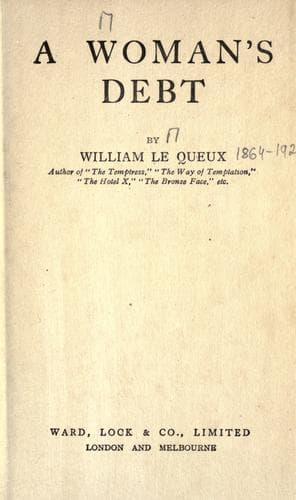
Detective and mystery stories; England -- Social life and customs -- 20th century -- Fiction; English fiction -- 20th century
The girl kissed him tenderly. Upright and honourable herself, she could
not but sympathize with him in his drastic action, even while she
was not without compassion for the wretched victim of his righteous
justice. And as she bestowed on him that affectionate caress, she could
not but think miserably of the havoc that had been wrought in that
small household in such a brief space of time.
Her memory went painfully back to that night in December when they had
sat in a secluded corner of one of the pretty rooms, and she had urged
her lover to screw up his courage to approach Morrice on the subject
of their marriage. They had then been a happy family of four, always
together, taking their pleasures, their amusements in common. And now
that joyous little band had been reduced to two. Mrs. Morrice, the aunt
for whom she had always entertained a sincere affection, was exiled,
justly exiled, from the home that had sheltered her for so many years.
And Richard, the lover in whose innocence she so firmly believed, was
another exile, lying under the ban of his benefactor’s displeasure, and
eating his heart out in that little cottage at Petersham.
“You do not blame me for what I have done, my little Rosabelle,”
repeated her uncle, as he held her slender form against his. “We have
both had a great sorrow in our lives, my poor child, we must be all in
all to each other now.”
“Oh, no, dearest uncle, I do not blame you. In her case, you had proved
everything up to the hilt. I do not see that you could have taken any
other course. If there had been the slightest room for doubt I should
have taken her part against you, I should have held that you were bound
to believe her innocent until you proved her guilty.”
He winced a little at those words, for he knew what was at the back of
her mind. He had tried and condemned Richard Croxton, the son of his
old sweetheart, on suspicion only—strong suspicion, it is true, but not
strong enough to justify absolute conviction.
They were interrupted by the entrance of the butler, a staid person who
had been in the financier’s service for over twenty years.
“A Mr. Lane rang up for you about half an hour ago, sir, and wished you
particularly to ring him up as soon as convenient to yourself.”
He went down to his room and was soon in communication with the office
in Shaftesbury Avenue. Lane’s measured tones came over the instrument.
“Good-day, Mr. Morrice. Am I right in concluding that a certain person
has left your house by now?”
“Quite right; has been gone since shortly after lunch,” was the
financier’s reply.
“Has not yet taken away any private property—trunks, boxes or that sort
of thing, I suppose?” was the next question.
“No; these are to be sent when we receive an address.”
“Good! Then I may run round to you at once? There is a little business
I want to embark on without delay.”
Public-domain text, read in full here on John Shaqi.
Reviews
Reviews
No reviews yet
Be the first to share your thoughts on this work.
Elsewhere in the archive
Join the Discussion
Join the discussion
Sign in to leave a comment or review.
Sign InorCreate an account