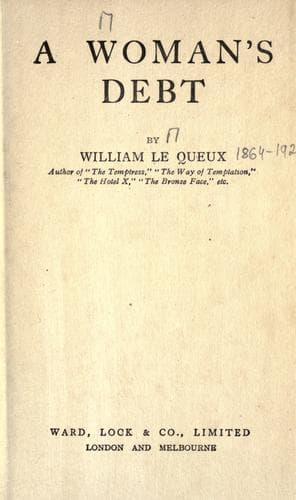
Detective and mystery stories; England -- Social life and customs -- 20th century -- Fiction; English fiction -- 20th century
And this was the story told by Mrs. Morrice, as she sat facing Lane in
the small but elegantly-furnished room of her friend Alma Buckley’s
flat. She told it throughout in a low voice which now and then broke
down, indicating that she was on the verge of tears. For the most part
it flowed forth in a continuous narrative, but now and then she paused
to answer some question, to give fuller details of some incident,
at the detective’s request. She informed him at the beginning that
although Miss Buckley knew much—she did not know everything—that she
was ignorant of the robberies.
Lane thought better of the music-hall artist after that. From the
readiness to tell a lie, he had judged her to be a fairly unscrupulous
woman, with full knowledge of her friend’s criminal acts, probably
drawing a handsome share of the proceeds. It was evident that she drew
the line at actual lawbreaking.
Lettice Larchester and her father had gone straight to London after
leaving Brinkstone, and established themselves in some cheap lodgings
in the Fulham district. Larchester had left the quiet little village
for more than one reason. For one thing he had grown tired of it,
had become weary of the ignorant people who frequented the bar of
the Brinkstone Arms, his visits to which constituted his sole social
recreation. Then the inspiration which he first derived from the
charming scenery around had waned in its intensity, and stimulated
him no longer. He was also rather weary of working continually at the
one theme of landscape, and trusted that by moving to London he might
break fresh ground amongst dealers and infuse variety into his rather
monotonous art.
This hope was not realized to any considerable extent. For the
first three months he displayed a certain feverish activity both in
the business and the artistic side of his calling, with decidedly
beneficial results to his exchequer. He was fairly moderate in his use
of alcohol; out of every payment he received for a picture he put a
small proportion in the Savings Bank for “a rainy day” as he announced
with importance to his hopeful daughter, who really began to believe
he had made up his mind to turn over a new leaf.
Alas, at the end of those three comparatively bright months, the old
deterioration set in, the old dissolute habits once again assumed
mastery of his relaxed will power. He had long bouts of intemperance,
during which he could not do a stroke of work. By degrees the small
savings were withdrawn from the bank to pay rent and purchase the bare
necessities of life.
Public-domain text, read in full here on John Shaqi.
Reviews
Reviews
No reviews yet
Be the first to share your thoughts on this work.
Elsewhere in the archive
Join the Discussion
Join the discussion
Sign in to leave a comment or review.
Sign InorCreate an account