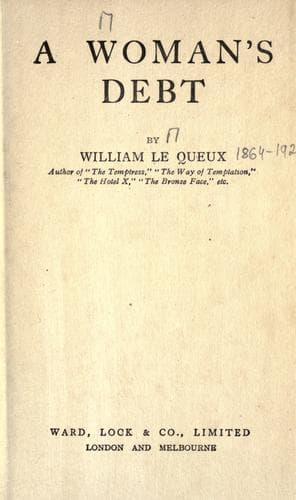
Detective and mystery stories; England -- Social life and customs -- 20th century -- Fiction; English fiction -- 20th century
She was about thirty when chance threw her in the way of Rupert
Morrice. They were both staying at the same hotel in Venice. He had
confided to her that he had experienced a bitter disappointment in his
youth, she was very kind and sympathetic. Something in her strongly
attracted him, she was not in love with him, but she admired and
respected him. He was not really in love with her, but they were on
equal terms in that respect.
There was a very brief courtship, in which Morrice learned as much of
her life story as she chose to tell him: it was embroidered here and
there with some unveracious details, for reasons which appeared good to
her at the time. And Lettice Larchester, otherwise Lettice Darcy, the
widow of the felon who had died in prison, became the wife of Rupert
Morrice the wealthy financier.
CHAPTER XXVII
IN VINO VERITAS
At the time of her second marriage, the friendship between the two
women was still unimpaired. They had not, of course, seen so much of
each other since Lettice had entered that new world into which Alma
Buckley refused to intrude, as much from disinclination as from
motives of policy. But there had never been a week in which they had
not met, at out-of-the way restaurants or in Alma’s flat when they were
quite certain of privacy.
The son was now a pretty little fellow of about eight, still living
with the same people with whom he had been placed soon after his birth.
His mother paid him visits from time to time under an assumed name. The
kindly couple who looked after him were childless themselves, and were
as fond of him as if they had been his real parents. Naturally they did
not fail to realize the situation, but they were not curious people,
and they never sought to penetrate the identity of the mother who paid
these periodical visits.
Had conditions been normal it is only reasonable to suppose that Mrs.
Morrice would have proved a fond and affectionate mother, and her
maternal feelings were often called into being by the gay prattle and
pretty ways of the charming little fellow who had been born in such
tragic circumstances. But she always came away sad from the visits, for
they brought the past so vividly before her. What would this innocent
child turn out when he grew to manhood? Would he inherit the criminal
instincts of his father? Well, although she could never acknowledge
him, she would do her duty by him—have him decently educated and when
the time came give him a fair start in life.
There could be no doubt that Miss Buckley was very devoted to her
friend, and always thinking of how she could best advance her
interests; it was one of those strong friendships that are rare amongst
men, still rarer amongst women. She had changed her, with advice and
stimulating counsel, from a despairing girl ready to sink under the
burden of her tragic misfortunes, into a resolute woman who faced the
future with some measure of hopefulness.
Public-domain text, read in full here on John Shaqi.
Reviews
Reviews
No reviews yet
Be the first to share your thoughts on this work.
Elsewhere in the archive
Join the Discussion
Join the discussion
Sign in to leave a comment or review.
Sign InorCreate an account