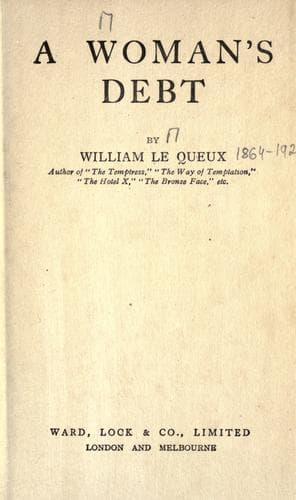
Detective and mystery stories; England -- Social life and customs -- 20th century -- Fiction; English fiction -- 20th century
“Yes, he has got his key; he always carries it with him. But I could
put the inside latch up, making some plausible excuse for doing so,
and while I was going to the door you could put things straight and
escape into my room, hide there and be smuggled out as soon as we got a
chance. What do you think of that?”
“Quite ingenious,” was the approving answer. No doubt the fellow would
have developed a very pretty talent in the domain of “crookdom” if he
had been properly trained by a qualified professor.
“Quite ingenious,” repeated Lane; “but I think I can manage it in a way
that will avert any danger from yourself if accidents should happen.
Now here is my plan. I will explain it as briefly as possible. You
won’t appear in the matter at all.”
Mr. Simmons heaved a sigh of relief. He looked at his new friend with
an air of admiration; he felt he was in the presence of a master mind.
The detective lucidly explained his scheme. “You meet me at the bottom
of the street to-morrow evening at seven o’clock, and hand me the key
of the flat. You come on here, I join you in five minutes; we have met
here as usual for a chat. I’m in a hurry; I stay with you a quarter of
an hour, then hasten off on the plea of having to attend to some urgent
business. I go on to the flat, take care that nobody is about, put the
key in the door, enter Sir George’s room and do my business. You will
sit here for an hour with your pals, then you will leave and meet me,
say, in the buffet of Victoria Station, when I will hand you back your
key.”
“It sounds all right,” said Mr. Simmons, still speaking dubiously.
“But what happens if Sir George ‘cops’ you, and you can’t meet me at
Victoria?”
“I’m coming to that, although there’s not the smallest probability
that Sir George will ‘cop’ me. If he does, I think I shall have
to say something to him that will prevent him from giving me in
charge. But whatever happens, all that can be proved against you is
indiscretion—mind you, rather unpardonable in a man of your years, but
still only indiscretion. So you tumble to it now?”
“I think I’m getting an inkling; but you might explain it fully. You
are a clever chap, and you make things seem so clear.”
“You met a very plausible stranger in a certain pub. Give the name
to show good faith. Your friends can prove they have seen us talking
together. You got rather pals; he stood you a lot of drinks. On this
particular evening he gave you a little too much, perhaps put something
in it to make you stupid, and while you were losing your wits, picked
your pocket of the key and rushed round to the flat, leaving you to
recover yourself. So remember, after I leave you to-morrow evening, to
be a little foolish in your manner for half an hour or so.”
“Excellent,” cried Mr. Simmons in genuine admiration. “By jingo, you
are a knock-out; you think of everything. To-morrow evening, just at
the bottom of the street; afterwards here. Now, what do you think of
something on account—say a ‘tenner.’”
Public-domain text, read in full here on John Shaqi.
Reviews
Reviews
No reviews yet
Be the first to share your thoughts on this work.
Elsewhere in the archive
Join the Discussion
Join the discussion
Sign in to leave a comment or review.
Sign InorCreate an account