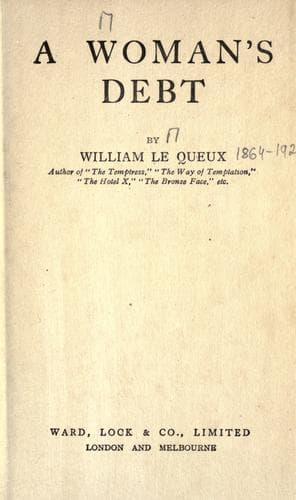
Detective and mystery stories; England -- Social life and customs -- 20th century -- Fiction; English fiction -- 20th century
She stood rooted to the spot. The young man’s preoccupied manner at the
lunch-table was accounted for. He was in some deep trouble from which
he was begging Mrs. Morrice to rescue him.
She heard her aunt reply in tones that were half angry, half tearful.
“How many times have you threatened me with that, and I have yielded. I
have half ruined myself for you; it cannot go on much longer.”
Suddenly she felt that she was listening to a conversation not intended
for her ears, and resolutely turned away and went to her own room. For
the present she would say nothing, not even to Dick, of what she had
heard by the purest accident. But she thought over it all the way on
the long drive to Petersham. Was there yet another tragedy going on in
the Morrice household, and was her placid-looking, dignified aunt the
centre of it?
And what was that alternative which Archie Brookes had described in
a whisper she could not catch? Had he threatened to destroy himself
if his request were not acceded to? And what did Mrs. Morrice mean by
saying she had half ruined herself for him?
CHAPTER XIV
AN ALARMING INTERRUPTION
Punctually at five o’clock on the appointed evening Lane and Simmons
met. On the face of the valet was a triumphant expression.
“We needn’t try this new scheme of yours, Mr. Cox—Mr. Lane, I should
say. I’ll come back to the flat with you; it’s all plain sailing. The
drawer is unlocked. The bank-book isn’t there, and he’s taken the
cheque-book with him; but he’s left the paying-in slips all right. You
said these would do.”
Not by any means for the first time was Gideon Lane impressed by the
inconsistencies of the human temperament. Here was a shrewd, clever
man like Sir George Clayton-Brookes, one who counted his cigars and
wine-bottles to prevent his valet helping himself to a surreptitious
smoke or drink! Surely he would be equally meticulous in other and
more important matters. And yet, he had gone away leaving that drawer
unlocked, its contents open to the prying eyes of Simmons.
The detective himself would never have done such a thing, and he was
quite sure he had less to conceal than this mysterious baronet who
passed himself off as a wealthy man, while all the evidence that had
been gathered pointed to the contrary. Perhaps Sir George, like many
other persons of considerable mentality—for there was little doubt
that he had brains of a certain order—entertained a great contempt for
the intelligence of his inferiors, and thought that if Simmons did pry
about in his absence he would not be much the wiser for his researches.
Public-domain text, read in full here on John Shaqi.
Reviews
Reviews
No reviews yet
Be the first to share your thoughts on this work.
Elsewhere in the archive
Join the Discussion
Join the discussion
Sign in to leave a comment or review.
Sign InorCreate an account