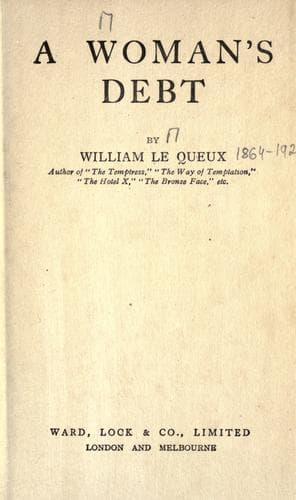
Detective and mystery stories; England -- Social life and customs -- 20th century -- Fiction; English fiction -- 20th century
By which it will be seen that Mr. Simmons, though perhaps not a high
authority on morals, had certain well-defined ethics of his own. It
was not stealing to abstract a cigar from the store of a master who
did not resort to the discreditable meanness of putting out a dozen in
a box at a time so that he would easily miss one; it was not wrong to
help yourself as often as you could to a glass of good wine; it was not
against the moral code to listen outside doors, or to read letters and
papers to which you could procure easy access through your employer’s
carelessness. But in some matters the valet was a purist, more, it
is to be feared, from terror of the legal consequences than from the
revolt of a tender conscience. He did draw the line at picking locks or
steaming open a letter.
Growing quite daring in his comfortable belief that they were engaged
in a comparatively innocent operation, he pulled the drawer open with
his own hands and pointed to the pale-coloured little book which
contained the paying-in slips.
“There it is; goes back for two months. Is that enough for you? I hope
so, for I don’t know where he puts the old ones; locks them up in his
safe, I expect.”
Lane intimated it would be quite sufficient for his purposes, and got
to work at once. He took careful notice of the exact position of the
little book which was lying at a slight angle on the top of a pile of
papers, so that he could replace it in the same position. Sir George,
careless as he appeared to be in some matters, might have a good memory
in certain things, and might notice on his return that the contents of
the drawer had been disturbed. Still, that did not matter very much if
he did suspect; his suspicions would naturally fall upon Simmons as
the guilty party, and, truth to tell, the detective was not very much
concerned about that individual. He had proved a useful and adaptable
instrument, but Lane could not help despising him for a smooth-faced
hypocrite and venal rogue.
It cannot be said that he enjoyed the situation very much himself. He
had taken this course because he could think of no other which would
serve his ends, and one has often to resort to dirty means in a good
cause. But even if Sir George was the scoundrel he was beginning to
believe him to be, the action he was now taking savoured just a little
too much of hitting below the belt to square with his stolid English
notions of fair play. If it had been possible he would have preferred
to come out more in the open. Still, all is fair in war; he had
comforted himself with that reflection many times in the course of his
active career.
It was not a very long task, for there seemed to be but few payments,
and those mostly for small sums. The name of Willis occurred frequently
in the margin of the counterfoils, evidently this was the person who
had paid the amounts to Sir George.
Public-domain text, read in full here on John Shaqi.
Reviews
Reviews
No reviews yet
Be the first to share your thoughts on this work.
Elsewhere in the archive
Join the Discussion
Join the discussion
Sign in to leave a comment or review.
Sign InorCreate an account