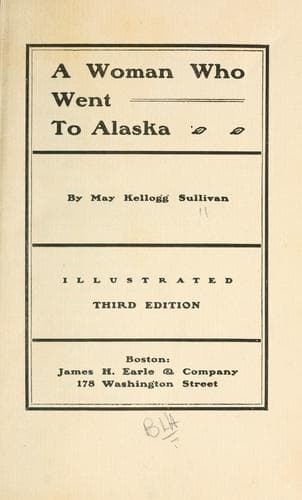
Alaska -- Description and travel; Frontier and pioneer life -- Alaska
Wednesday, November seventh: The weather is beautifully clear and sunny
today, with charming sky effects at sunrise and sunset. Red, yellow and
crimson lines stretched far along the eastern horizon, cut by vertical
ones of lighter tints, until a big golden ball climbed up higher, and by
his increased strength warmed the whole snowy landscape. A few hours
later, this great yellow ball, looking bright and clear-cut, like
copper, sank gently beneath the long banks of purple-red clouds massed
in artistic and majestic confusion. Everything, at this time, was
enveloped in the cooler, quieter tints of purple and blue, and hills,
peaks, and icy bay all lay bathed in exquisite color.
The two Eskimos brought the reindeer back from the Home today, stopped
for lunch, and then went on their way to the herd again. Ricka, Alma
and Miss J. went out as far as the cliff for a ride on the sleds behind
the deer, but I felt safer indoors. Ricka says when the animals dashed
over the big bank, out upon the ice near the cliff, she thought her last
hour had come. At first the deer trotted steadily along on the trail,
but going faster and faster they rushed headlong through the drifts,
dragging the sleds on one runner, and tearing up the snow like a
blizzard as they went, until it seemed to the two girls, unused to such
riding as they were, that the animals were running away, and they would
be certainly killed.
Miss J. was quite used to this kind of traveling, and made no outcry,
but Alma and Ricka finally got the natives to stop the deer and let them
get off and walk home, saying it might be great fun when one was
accustomed to it.
The sleds used by the natives are called reindeer sleds because made
especially for use when driving deer. They are close to the ground, and
very strongly built, as they could not otherwise stand the wear and tear
of such "rapid transit." Side rails are put on, but no high handle-bar
at the back, and when a load is placed upon the sled it is lashed
securely on with ropes or thongs made of seal or walrus hide; otherwise
there would be no load before the journey was completed.
Mr. H. says he has long experience with them, but never feels quite sure
that an animal will do what is wanted of him, though when driven by
natives who are well used to their tricks and antics, especially if the
animals have reached mature age, they make good travelers, and get over
the ground very fast. A hundred miles a day is nothing to them if the
snow is not too deep and their load reasonable.
Men and dog-teams are coming into camp from Nome each day now, and say
that the trails are in first-class condition. We hope for mail soon from
Nome. Mr. H. came, bringing with him a Swedish preacher who is wintering
here, though not officially connected with the Mission. He is a sweet
singer, liking well to accompany his Swedish songs upon the guitar or
organ, for he plays both instruments.
Public-domain text, read in full here on John Shaqi.
Reviews
Reviews
No reviews yet
Be the first to share your thoughts on this work.
Elsewhere in the archive
Join the Discussion
Join the discussion
Sign in to leave a comment or review.
Sign InorCreate an account