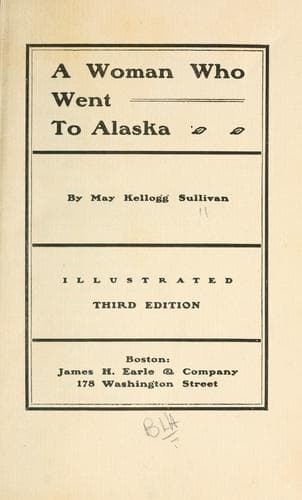
Alaska -- Description and travel; Frontier and pioneer life -- Alaska
When the high tide came, we floated off the bar, but the scene was one
of dull monotony, and it was not until the day following that we came
into the hill country, and I was permitted to again see the dear trees I
loved so well, not one of which I had seen since leaving California.
At Anvik there came on board a little missionary teacher bound for
Philadelphia, who had spent seven years with the natives in this
Episcopal Mission without a vacation, and her stories were interesting
in the extreme.
Our days were uneventful. A broken stern wheel, enforced rests upon sand
bars, frequent stops at wood yards with a few moments run upon shore in
which to gather autumn leaves, and get a sniff of the woods, this was
our life upon the Yukon steamer for many days. After a while the nights
grew too dark for safe progress, and the boat was tied up until
daylight.
Russian Mission, Tanana, Rampart, Fort Yukon and the Flats were passed,
and the days wore tediously on. We were literally worming our way up
stream, with low water and dark nights to contend with, but a second
summer was upon us with warm, bright sunshine, and the hills were
brilliantly colored.
One morning we approached the towering Roquett Rock, so named by
Lieutenant Frederick Schwatka in his explorations down the Yukon years
before, and connected with which is an Indian legend of some interest.
This immense rock (so the story runs) once formed a part of the western
shore of the Yukon, and was one of a pair of towering cliffs of about
the same size, and with similar characteristics. Here the two huge
cliffs lived for many geological periods in wedded bliss as man and
wife, until finally family dissensions invaded the rocky household, and
ended by the stony-hearted husband kicking his wrangling wife into the
distant plain, and changing the course of the great river so that it
flowed between them, to emphasize the perpetual divorce. The cliff and
the rock are still known as "the old man" and "the old woman," the
latter standing in isolation upon a low, flat island with the muddy
Yukon flowing on both sides.
At this time of the year the days in Alaska grow perceptibly shorter,
and we were not surprised to find dusky twilight at five in the
afternoon, and to notice the eerie loneliness of the dark, sweet scented
woods a few hours later, when the steamer lay tied to the river's bank.
One night after dinner a number of passengers sat idly about in the
saloon of our steamer. Many had grown tired of cards, or had lost their
money, and, finding themselves pitted against more lucky players, had
called a halt and looked for other occupation. Miners lounged about,
chatting of the gold mines, their summer's work and experiences. Big
Curly and his little black-eyed wife listened attentively for a time.
The old miner was a born story teller, and knew a good yarn when he
heard it. The boat was tied up for the night, and all was quiet around
us. It was the time and place for a story.
Public-domain text, read in full here on John Shaqi.
Reviews
Reviews
No reviews yet
Be the first to share your thoughts on this work.
Elsewhere in the archive
Join the Discussion
Join the discussion
Sign in to leave a comment or review.
Sign InorCreate an account