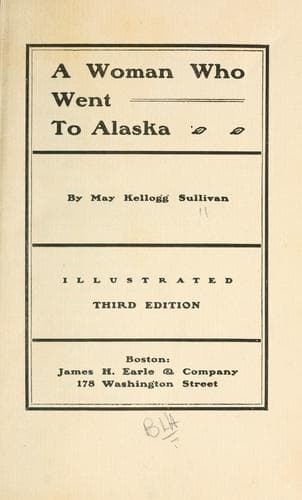
Alaska -- Description and travel; Frontier and pioneer life -- Alaska
The second of these, the foreman, was dressed also in great rubber
boots, dark blue sweater, and broad-brimmed felt hat, with a quick eye
and ear for all around him, though he was a man of few words, which he
weighed well before using. His hip pocket always contained a loaded
revolver, and he was obliged to sleep days after being on duty nights.
To eyes so unaccustomed as ours to the sight, how strange it all looked
at midnight. From the big tent door which faced south and towards Nome
City we could see the blue waters of Behring Sea away in the distance.
Great ships lying there at anchor, lately arrived from the outside world
or just about to leave, laden with treasure, at this long range looked
like mere dots on the horizon. Between them and us there straggled over
the beach in a westerly direction, a confused group of objects we well
knew to be the famous and fast growing camp on the yellow sands. To our
right, as well as our left, rolled the softly undulating hills, glowing
in tender tints of purples and greys, or, if the moon hung low above our
heads, there were warmer and lighter shades which were doubly
entrancing.
Accompanying the low moon twinkled the silver stars with their olden
time coyness of expression. Little birds, not knowing when to sleep in
the endless daylight, hopped among the dewy wild flowers of the tundra,
calling to their mates or nestlings, twittering a song appropriate to
the time and place because entirely unfamiliar.
No other sound was to be heard except the picks of the miners at work in
the stream. No word was spoken unless the foreman gave some order. Those
sleeping in nearby tents must not be wakened, and besides the men at the
shovels and picks did no loitering. There were the long sluice boxes to
be filled with what was once the creek bed, from which the water was now
turned in another direction to await the morning's cleanup of gold.
At that time the water would be conducted into the long boxes to wash
away the dirt and gravel, leaving the heavier gold in the bottom. Either
Mr. A. or his brother, with the foreman, attended to cleaning up the
gold. When all the dirt and gravel, or rock, had been washed out of the
sluices, a whisk broom was used to brush the gold into a corner of the
box, a dustpan conveyed it to broad-mouthed gold pans close at hand, and
these were carried into the kitchen.
Here the pans were placed upon the iron range, big mush spoons were
utilized for stirring, and the precious metal was well dried before
being weighed. As soon as possible afterward it was taken to the Bank of
Nome. A tall, black horse was purchased for this purpose alone, and
after a few such trips the intelligent creature most reluctantly
approached the office where the gold was kept, having learned of the
grievous burden he would have to bear. Sometimes he would snort, throw
himself and pull back, and in every way show his unwillingness to
proceed.
Public-domain text, read in full here on John Shaqi.
Reviews
Reviews
No reviews yet
Be the first to share your thoughts on this work.
Elsewhere in the archive
Join the Discussion
Join the discussion
Sign in to leave a comment or review.
Sign InorCreate an account