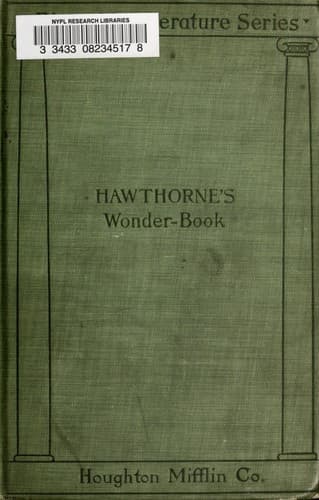
A Wonder Book for Girls & BoysHawthorne, Nathaniel
General
A Wonder Book for Girls & Boys
Hawthorne, Nathaniel
Mythology, Greek; Mythology, Greek -- Juvenile literature
"Why, I am very nimble, as you see," answered the traveler. "So, if
you call me Quicksilver, the name will fit tolerably well."
"Quicksilver? Quicksilver?" repeated Philemon, looking in the
traveler's face, to see if he were making fun of him. "It is a very
odd name! And your companion there? Has he as strange a one?"
"You must ask the thunder to tell it you!" replied Quicksilver,
putting on a mysterious look. "No other voice is loud enough."
This remark, whether it were serious or in jest, might have caused
Philemon to conceive a very great awe of the elder stranger, if, on
venturing to gaze at him, he had not beheld so much beneficence in
his visage. But, undoubtedly, here was the grandest figure that ever
sat so humbly beside a cottage door. When the stranger conversed, it
was with gravity, and in such a way that Philemon felt irresistibly
moved to tell him everything which he had most at heart. This is
always the feeling that people have, when they meet with any one wise
enough to comprehend all their good and evil, and to despise not a
tittle of it.
But Philemon, simple and kind-hearted old man that he was, had not
many secrets to disclose. He talked, however, quite garrulously, about
the events of his past life, in the whole course of which he had never
been a score of miles from this very spot. His wife Baucis and himself
had dwelt in the cottage from their youth upward, earning their bread
by honest labor, always poor, but still contented. He told what
excellent butter and cheese Baucis made, and how nice were the
vegetables which he raised in his garden. He said, too, that, because
they loved one another so very much, it was the wish of both that
death might not separate them, but that they should die, as they had
lived, together.
As the stranger listened, a smile beamed over his countenance, and
made its expression as sweet as it was grand.
"You are a good old man," said he to Philemon, "and you have a good
old wife to be your helpmeet. It is fit that your wish be granted."
And it seemed to Philemon, just then, as if the sunset clouds threw up
a bright flash from the west, and kindled a sudden light in the sky.
Baucis had now got supper ready, and, coming to the door, began to
make apologies for the poor fare which she was forced to set before
her guests.
"Had we known you were coming," said she, "my good man and myself
would have gone without a morsel, rather than you should lack a better
supper. But I took the most part of to-day's milk to make cheese; and
our last loaf is already half eaten. Ah me! I never feel the sorrow of
being poor, save when a poor traveler knocks at our door."
"All will be very well; do not trouble yourself, my good dame,"
replied the elder stranger, kindly. "An honest, hearty welcome to a
guest works miracles with the fare, and is capable of turning the
coarsest food to nectar and ambrosia."
Public-domain text, read in full here on John Shaqi.
Reviews
Reviews
No reviews yet
Be the first to share your thoughts on this work.
Elsewhere in the archive
Join the Discussion
Join the discussion
Sign in to leave a comment or review.
Sign InorCreate an account