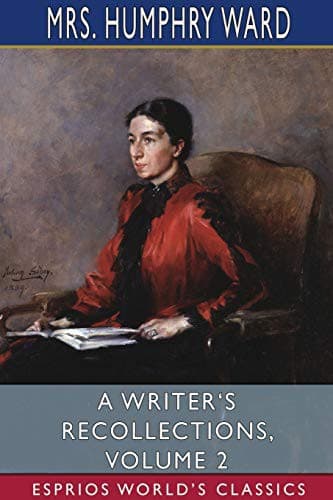
A Writer's Recollections — Volume 2Ward, Humphry, Mrs.
General
A Writer's Recollections — Volume 2
Ward, Humphry, Mrs.
Novelists, English -- 19th century -- Biography; Novelists, English -- 20th century -- Biography; Ward, Humphry, Mrs., 1851-1920
Yes!--
... He was a priest to us all
Of the wonder and bloom of the world,
Which we saw with his eyes and were glad.
For that was indeed true of Henry James as of Wordsworth. The "wonder
and bloom," no less than the ugly or heartbreaking things, which, like
the disfiguring rags of old Laertes, hide them from us--he could weave
them all, with an untiring hand, into the many-colored web of his art.
Olive Chancellor, Madame Mauve, Milly, in _The Wings of a Dove_--the
most exquisite, in some ways, of all his women--Roderick Hudson, St.
George, the woman doctor in the _Bostonians,_ the French family in the
_Reverberation_, Brooksmith--and innumerable others--it was the wealth
and facility of it all that was so amazing! There is enough observation
of character in a chapter of the _Bostonians,_ a story he thought little
of, and did not include in his collected edition, to shame a Wells novel
of the newer sort, with its floods of clever, half-considered journalism
in the guise of conversation, hiding an essential poverty of creation.
_Ann Veronica_ and the _New Machiavelli_, and several other tales by the
same writer, set practically the same scene, and handle the same
characters under different names. Of an art so false and confused Henry
James could never have been capable. His people, his situations, have
the sharp separateness--and something of the inexhaustibleness--of
nature, which does not mix her molds.
As to method, naturally I often discussed with him some of the difficult
problems of presentation. The posthumous sketches of work in progress,
published since his death, show how he delighted in these problems, in
their very difficulties, in their endless opportunities. As he often
said to me, he could never read a novel that interested him without
taking it mentally to pieces and rewriting it in his own way. Some of
his letters to me are brilliant examples of this habit of his.
Technique, presentation, were then immensely important to him; important
as they never could have been to Tolstoy, who probably thought very
little consciously about them. Mr. James, as we all know, thought a
great deal about them--sometimes, I venture to think, too much. In _The
Wings of a Dove_, for instance, a subject full of beauty and tragedy is
almost spoiled by an artificial technique, which is responsible for a
scene on which, as it seems to me, the whole illusion of the book is
shattered. The conversation in the Venice apartment where the two
fiancé's--one of whom, at least, the man, is commended to our sympathy
as a decent and probable human being--make their cynical bargain in the
very presence of the dying Milly, for whose money they are plotting, is
in some ways a _tour de force_ of construction. It is the central point
on which many threads converge and from which many depart. But to my
mind, as I have said, it invalidates the story. Mr. James is here
writing as a _virtuoso_, and not as the great artist we know him to be.
Public-domain text, read in full here on John Shaqi.
Reviews
Reviews
No reviews yet
Be the first to share your thoughts on this work.
Elsewhere in the archive
Join the Discussion
Join the discussion
Sign in to leave a comment or review.
Sign InorCreate an account