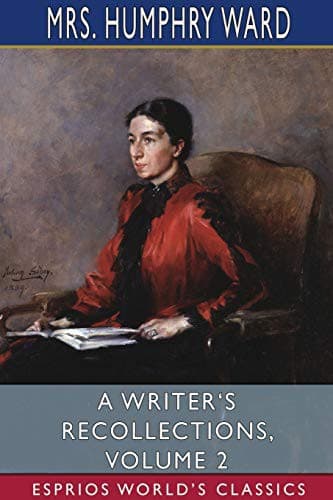
A Writer's Recollections — Volume 2Ward, Humphry, Mrs.
General
A Writer's Recollections — Volume 2
Ward, Humphry, Mrs.
Novelists, English -- 19th century -- Biography; Novelists, English -- 20th century -- Biography; Ward, Humphry, Mrs., 1851-1920
So the full weeks passed on. Half _Eleanor_ had been written, and in
June we turned homeward. But before then, one visitor came to the Villa
Barberini in our last weeks there, who brought with him, for myself, a
special and peculiar joy. My dear father, with his second wife, arrived
to spend a week with us. Never before, throughout all his ardent
Catholic life, had it been possible for him to tread the streets of Rome
or kneel in St. Peter's. At last, the year before his death, he was to
climb the Janiculum, and to look out over the city and the plain whence
Europe received her civilization and the vast system of the Catholic
Church. He felt as a Catholic; but hardly less as a scholar, one to whom
Horace and Virgil had been familiar from his boyhood, the greater
portion of them known by heart, to a degree which is not common now. I
remember well that one bright May morning at Castle Gandolfo, he
vanished from the villa, and presently, after some hours, reappeared
with shining eyes.
"I have been on the Appian Way--I have walked where Horace walked!"
In his own autobiography he writes: "In proportion to a man's good sense
and soundness of feeling are the love and admiration, increasing with
his years, which he bears toward Horace." An old-world judgment, some
will say, which to us, immersed in this deluge of war which is changing
the face of all things, may sound, perhaps, as a thin and ghostly voice
from far away. It comes from the Oxford of Newman and Matthew Arnold, of
Jowett and Clough; and for the moment, amid the thunder and anguish of
our time, it is almost strange to our ears. But when the tumult and the
shouting die, and "peace has calmed the world," whatever else may have
passed, the poets and the thinkers will be still there, safe in their
old shrines, for they are the "ageless mouths" of all mankind, when men
are truly men. The supposed reformers, who thirst for the death of
classical education, will not succeed, because man doth not live by
bread alone, and certain imperishable needs in him have never been so
fully met as by some Greeks and some Latins, writing in a vanished
society, which yet, by reason of their thought and genius, is still in
some real sense ours. More science? More foreign languages? More
technical arts? Yes! All these. But if democracy is to mean the
disappearance of the Greek and Latin poets from the minds of the future
leaders of our race, the history of three thousand years is there to
show what the impoverishment will be.
Public-domain text, read in full here on John Shaqi.
Reviews
Reviews
No reviews yet
Be the first to share your thoughts on this work.
Elsewhere in the archive
Join the Discussion
Join the discussion
Sign in to leave a comment or review.
Sign InorCreate an account