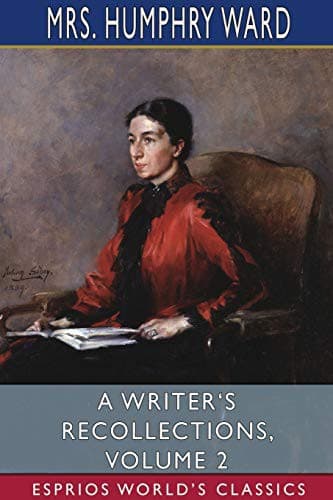
A Writer's Recollections — Volume 2Ward, Humphry, Mrs.
General
A Writer's Recollections — Volume 2
Ward, Humphry, Mrs.
Novelists, English -- 19th century -- Biography; Novelists, English -- 20th century -- Biography; Ward, Humphry, Mrs., 1851-1920
On the religious development of the last thirty years I can find but
little that is gladdening, to myself, at any rate, to say. There are
ferments going on in the Church of England which have shown themselves
in a series of books produced by Oxford and Cambridge men, each of them
representing some greater concession to modern critical and historical
knowledge than the one before it. The war, no doubt, has gripped the
hearts and stirred the minds of men, in relation to the fundamental
problems of life and destiny, as nothing else in living experience has
ever done. The religious minds among the men who are perpetually
fronting death in the battle-line seem to develop, on the one hand, a
new and individual faith of their own, and, on the other, an instinctive
criticism of the faiths hitherto offered them, which in time may lead us
far. The complaints, meanwhile, of "empty churches" and the failing hold
of the Church of England, are perhaps more persistent and more
melancholy than of old; and there is a general anxiety as to how the
loosening and vivifying action of the war will express itself
religiously when normal life begins again. The "Life and Liberty"
movement in the Anglican Church, which has sprung up since the war, is
endeavoring to rouse a new Christian enthusiasm, especially among the
young; and with the young lies the future. But the war itself has
brought us no commanding message, though all the time it may be silently
providing the "pile of gray heather" from which, when the moment comes,
the beacon-light may spring.
The greatest figure in the twenty years before the war seems to me to
have been George Tyrrell. The two volumes of his biography, with all
their absorbing interest, have not, I think, added much to the effect of
his books. _A Much-abused Letter, Lex Orandi, Scylla and
Charybdis_, and _Christianity at the Cross-Roads_ have settled
nothing. What book of real influence does? They present many
contradictions; but are thereby, perhaps, only the more living. For one
leading school of thought they go not nearly far enough; for another a
good deal too far. But they contain passages drawn straight from a
burning spiritual experience, passages also of a compelling beauty,
which can hardly fall to the ground unfruitful. Whether as Father
Tyrrell's own, or as assimilated by other minds, they belong, at least,
to the free movement of experimental and inductive thought, which, in
religion as in science, is ever the victorious movement, however
fragmentary and inconclusive it may seem at any given moment to be.
Other men--Doctor Figgis, for instance--build up shapely and plausible
systems, on given material, which, just because they are plausible and
shapely, can have very little to do with truth. It is the seekers, the
men of difficult, half-inspired speech, like T. H. Green and George
Tyrrell, through whose work there flashes at intervals the "gleam" that
lights human thought a little farther on its way.
Public-domain text, read in full here on John Shaqi.
Reviews
Reviews
No reviews yet
Be the first to share your thoughts on this work.
Elsewhere in the archive
Join the Discussion
Join the discussion
Sign in to leave a comment or review.
Sign InorCreate an account