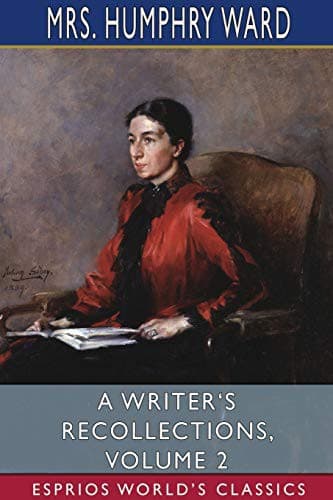
A Writer's Recollections — Volume 2Ward, Humphry, Mrs.
General
A Writer's Recollections — Volume 2
Ward, Humphry, Mrs.
Novelists, English -- 19th century -- Biography; Novelists, English -- 20th century -- Biography; Ward, Humphry, Mrs., 1851-1920
Sixteen years later came his famous resignation, in 1878, when the Fleet
was ordered to the Dardanelles, and Lord Derby, as he had now become,
then Foreign Secretary, refused to sanction a step that might lead to
war. That, for him, was the end as far as Toryism was concerned. In 1880
he joined Mr. Gladstone, but only to separate from him on Home Rule in
1886; and when I first knew him, in 1891, he was leader of the Liberal
Unionist peers in the House of Lords. A little later he became President
of the great Labor Commission in 1892, and before he could see
Gladstone's fresh defeat in 1893, he died.
Speculatively he was as open-minded as a reader and follower of Mill
might be expected to be. He had been interested in _Robert Elsmere_, and
the discussion of books and persons, to which it led him in conversation
with me, showed him fully aware of the new forces abroad in literature
and history. Especially interested, too, as to what Labor was going to
make of Christianity, and well aware--how could he fail to be, as
Chairman of that great, that epoch-making Commission of 1892?--of the
advancing strength of organized labor on all horizons. He appeared to
me, too, as a typical North-countryman--a son of Lancashire, proud of
the great Lancashire towns, and thoroughly at home in the life of the
Lancashire countryside. He could tell a story in dialect admirably. And
I realized that he had thought much--in his balanced, reticent way--on
matters in which I was then groping: how to humanize the relations
between employer and employed, how to enrich and soften the life of the
workman, how, in short, to break down the barrier between modern
industrialism and the stored-up treasures--art, science, thought--of
man's long history.
So that when _David Grieve_ was finished I sent it to Lord Derby, not
long after our first meeting, in no spirit of empty compliment, and I
have always kept his letter in return as a memento of a remarkable
personality. Some day I hope there may be a Memoir of him; for none has
yet appeared. He had not the charm, the versatility, the easy classical
culture, of his famous father--"the Rupert of debate." But with his
great stature--he was six feet two--his square head, and strong,
smooth-shaven face, he was noticeable everywhere. He was a childless
widower when I first knew him, and made the impression of a lonely man,
for all his busy political life and his vast estates. But he was
particularly interesting to me as representing a type I have once or
twice tried to draw--of the aristocrat standing between the old world,
before railways and the first Reform Bill, which saw his birth, and the
new world and new men of the later half of the century. He was
traditionally with the old world; by conviction and conscience, I think,
with the new; yet not sorry, probably, that he was to see no more than
its threshold!
Public-domain text, read in full here on John Shaqi.
Reviews
Reviews
No reviews yet
Be the first to share your thoughts on this work.
Elsewhere in the archive
Join the Discussion
Join the discussion
Sign in to leave a comment or review.
Sign InorCreate an account