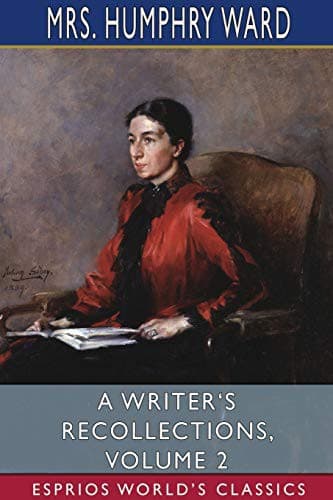
A Writer's Recollections — Volume 2Ward, Humphry, Mrs.
General
A Writer's Recollections — Volume 2
Ward, Humphry, Mrs.
Novelists, English -- 19th century -- Biography; Novelists, English -- 20th century -- Biography; Ward, Humphry, Mrs., 1851-1920
Some of the most interesting letters that reached me about it were from
men of affairs who were voracious readers, but not makers of books--such
as Mr. Goschen, who "could stand an examination on it"; Sir James,
afterward Lord Hannen, one of the Judges of the Parnell Commission; and
Lord Derby, the Minister who seceded, with Lord Carnarvon, from
Disraeli's Government in 1878. We had made acquaintance not long before
with Lord Derby, through his niece, Lady Winifred Byng (now Lady
Burghclere), to whom we had all lost our hearts--children and
parents--at Lucerne in 1888. There are few things I regret more in
relation to London social life than the short time allowed me by fate
wherein to see something more of Lord Derby. If I remember right, we
first met him at a small dinner-party at Lady Winifred's in 1891, and he
died early in 1893. But he made a very great impression upon me, and,
though he was generally thought to be awkward and shy in general
society, in the conversations I remember with him nothing could have
been more genial or more attractive than his manner. He had been at
Rugby under my grandfather, which was a link to begin with; though he
afterward went to Cambridge, and never showed, that I know of, any signs
of the special Rugby influence which stamped men like Dean Stanley and
Clough. And yet of the moral independence and activity which my
grandfather prized and cultivated in his boys, there was certainly no
lack in Lord Derby's career. For the greater part of his political life
he was nominally a Conservative, yet the rank and file of his party only
half trusted a mind trained by John Stuart Mill and perpetually brooding
on social reform. As Lord Stanley, his close association and personal
friendship with Disraeli during the Ministries and politics of the
mid-nineteenth century have been well brought out in Mr. Buckle's last
volume of the Disraeli _Life_. But the ultimate parting between himself
and Dizzy was probably always inevitable. For his loathing of
adventurous policies of all kinds, and of any increase whatever in the
vast commitments of England, was sure at some point to bring him into
conflict with the imagination or, as we may now call it, the prescience,
of Disraeli. It was strange to remember, as one watched him at the
dinner-table, that he had been offered the throne of Greece in 1862.
If he accepts the charge [wrote Dizzy to Mrs. Bridges Williams] I shall
lose a powerful friend and colleague. It is a dazzling adventure for the
House of Stanley, but they are not an imaginative race, and I fancy they
will prefer Knowsley to the Parthenon, and Lancashire to the Attic
plain. It is a privilege to live in this age of rapid and brilliant
events. What an error to consider it an utilitarian age! It is one of
infinite romance. Thrones tumble down and crowns are offered like a
fairy-tale.
Public-domain text, read in full here on John Shaqi.
Reviews
Reviews
No reviews yet
Be the first to share your thoughts on this work.
Elsewhere in the archive
Join the Discussion
Join the discussion
Sign in to leave a comment or review.
Sign InorCreate an account