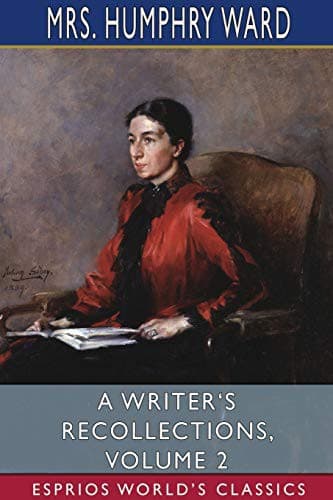
A Writer's Recollections — Volume 2Ward, Humphry, Mrs.
General
A Writer's Recollections — Volume 2
Ward, Humphry, Mrs.
Novelists, English -- 19th century -- Biography; Novelists, English -- 20th century -- Biography; Ward, Humphry, Mrs., 1851-1920
On the threshold also of the Settlement's early history there stands the
venerable figure of James Martineau--thinker and saint. For he was a
member of the original Council, and his lectures on the Gospel of St.
Luke, in the old "Elsmerian" hall, marked the best of what we tried to
give in those first days. I knew Harriet Martineau in my childhood at
Fox How. Well I remember going to tea with that tremendous woman when I
was eight years old; sitting through a silent meal, in much awe of her
cap, her strong face, her ear-trumpet; and then being taken away to a
neighboring room by a kind niece, that I might not disturb her further.
Once or twice, during my growing up, I saw her. She lived only a mile
from Fox How, and was always on friendly terms with my people. Matthew
Arnold had a true admiration for her--sturdy fighter that she was in
Liberal causes. So had W.E. Forster; only he suffered a good deal at her
hands, as she disapproved of the Education Bill, and contrived so to
manage her trumpet when he came to see her as to take all the argument
and give him all the listening! When my eldest child was born, a
cot-blanket arrived, knitted by Miss Martineau's own hands--the busy
hands (soon then to be at rest) that wrote the _History of the Peace_,
_Feats on the Fiord_, the _Settlers at Home_, and those excellent
biographical sketches of the politicians of the Reform and Corn Law days
in the _Daily News_, which are still well worth reading.
Between Harriet Martineau and her brother James, as many people will
remember, there arose an unhappy difference in middle life which was
never mended or healed. I never heard him speak of her. His standards
were high and severe, for all the sensitive delicacy of his long,
distinguished face and visionary eyes; and neither he nor she was of the
stuff that allows kinship to supersede conscience. He published a
somewhat vehement criticism of a book in which she was part author, and
she never forgave it. And although to me, in the University Hall
venture, he was gentleness and courtesy itself, and though his presence
seemed to hallow a room directly he entered it, one felt always that he
was _formidable_. The prophet and the Puritan lay deep in him. Yet in
his two famous volumes of Sermons there are tones of an exquisite
tenderness and sweetness, together with harmonies of prose style, that
remind me often how he loved music and how his beautiful white head
might be seen at the Monday Popular Concerts, week after week, his
thinker's brow thrown back to catch the finest shades of
Joachim's playing.
The year after _David Grieve_ appeared, Mr. Jowett died. His long letter
to me on the book contained some characteristic passages, of which I
quote the following:
Public-domain text, read in full here on John Shaqi.
Reviews
Reviews
No reviews yet
Be the first to share your thoughts on this work.
Elsewhere in the archive
Join the Discussion
Join the discussion
Sign in to leave a comment or review.
Sign InorCreate an account