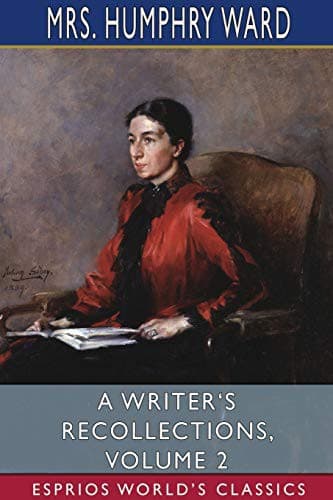
A Writer's Recollections — Volume 2Ward, Humphry, Mrs.
General
A Writer's Recollections — Volume 2
Ward, Humphry, Mrs.
Novelists, English -- 19th century -- Biography; Novelists, English -- 20th century -- Biography; Ward, Humphry, Mrs., 1851-1920
But it was not till 1897, as he himself records, that the indomitable
spirit so far yielded to these limitations as to resign--or rather
contemplate resigning--the second great task of which he had spoken to
me at Oxford, nine years before. "I have begun seriously to ask myself
whether I shall ever be able to face--_The Olympian Religion_."
It was, I think, in the winter of 1895 that I saw him for the last time
at our neighbors', the Rothschilds, at Tring Park. He was then full of
animation and talk, mainly of things political, and, indeed, not long
before he had addressed a meeting at Chester on the Turkish massacres in
Armenia, and was still to address a large audience at Liverpool on the
same subject--his last public appearance--a year later. When _George
Tressady_ appeared he sent me a message through Mrs. Drew that he feared
George Tressady's Parliamentary conduct "was inconceivable in a man of
honor"; and I was only comforted by the emphatic and laughing dissent of
Lord Peel, to whom I repeated the verdict. "Nothing of the kind! But of
course he was thinking of _us_--the Liberal Unionists."
Then came the last months when, amid a world's sympathy and reverence,
the great life, in weariness and pain, wore to its end. The "lying in
state" in Westminster Hall seemed to me ill arranged. But the burying
remains with me as one of those perfect things, which only the Anglican
Church at its best, in combination with the immemorial associations of
English history, can achieve. After it, I wrote to my son:
I have now seen four great funerals in the Abbey--Darwin, Browning,
Tennyson, and the funeral service for Uncle Forster, which was very
striking, too. But no one above forty of those in the Abbey
yesterday will ever see the like again. It was as beautiful and
noble as the "lying in state" was disappointing and ugly. The music
was exquisite, and fitting in every respect; and when the high
sentence rang out, "and their name liveth for evermore," the effect
was marvelous. One seemed to hear the voice of the future already
pealing through the Abbey--as though the verdict were secured, the
judgment given.
Public-domain text, read in full here on John Shaqi.
Reviews
Reviews
No reviews yet
Be the first to share your thoughts on this work.
Elsewhere in the archive
Join the Discussion
Join the discussion
Sign in to leave a comment or review.
Sign InorCreate an account