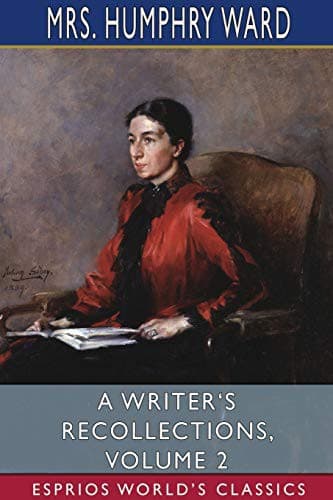
A Writer's Recollections — Volume 2Ward, Humphry, Mrs.
General
A Writer's Recollections — Volume 2
Ward, Humphry, Mrs.
Novelists, English -- 19th century -- Biography; Novelists, English -- 20th century -- Biography; Ward, Humphry, Mrs., 1851-1920
J.M. Barrie's generous, enthusiastic note delights and inspires me again
as I read it over. Mr. Morley, my old editor and critic, wrote: "I find
it intensely interesting and with all the elements of beauty, power, and
pathos." For Leslie Stephen, with whom I had only lately made warm and
close friends, I had a copy bound, without the final chapter, that the
book might not, by its tragic close, depress one who had known so much
sorrow. Sir Alfred Lyall thought--"the story reaches a higher pitch of
vigor and dramatic presentation than is to be found even in your later
books"; while Lord Halifax's letter--"how lovable they both are, each in
his way, and how true to the ideal on both sides!"--and others, from Mr.
Godkin, of the American _Nation_, from Frederic Harrison, Lord Goschen,
Lord Dufferin, and many, many more, produced in me that curious mood
which for the artist is much nearer dread than boasting--dread that the
best is over and that one will never earn such sympathy again. One
letter not written to myself, from Mr. George Wyndham to Mr. Wilfred
Ward, I have asked leave to print as a piece of independent criticism:
On Sunday I read _Helbeck of Bannisdale_, and I confess that the
book moved me a great deal. It is her best book. It is a true
tragedy, because the crash is inevitable. This is not so easy to
effect in Art as many suppose. There are very few characters and
situations which lead to inevitable crashes. It is a thousand to one
that a woman who thinks she ought not to marry a man, but loves him
passionately, will, in fact, marry him. She will either discover an
ingenious way out of her woods or else just shut her eyes and "go it
blind," relying on his strength and feeling that it is really right
to relinquish to him her sense of responsibility. In choosing a girl
with nothing left her in the world but loyalty to a dead father and
memory of his attitude toward religion, without knowledge of his
arguments for that attitude, I think that Mrs. Ward has hit on the
only possible _persona_. Had Laura, herself, been a convinced
rationalist, or had her father been still alive, she would have
merged herself and her attitude in Helbeck's strength of character.
Being a work of art, self-consistent and inevitable, the book
becomes symbolic. It is a picture of incompatibility, but, being a
true picture, it is a symbolic index to the incompatible which plays
so large a part in the experience of man.
Public-domain text, read in full here on John Shaqi.
Reviews
Reviews
No reviews yet
Be the first to share your thoughts on this work.
Elsewhere in the archive
Join the Discussion
Join the discussion
Sign in to leave a comment or review.
Sign InorCreate an account