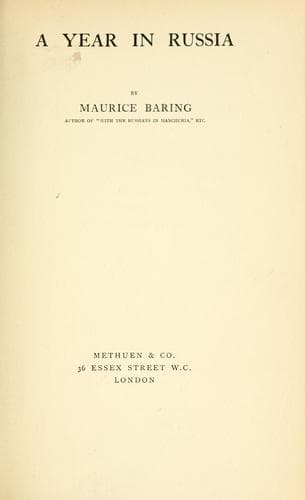
Russia -- History -- Revolution, 1905-1907; Russia -- Politics and government -- 1894-1917; Russia -- Social conditions -- 1801-1917
The popular attitude towards Count Witte during the last year must be of
singular interest to those to whom the contemplation of human affairs
affords a melancholy amusement. The enthusiasm with which the hero of
Portsmouth was received; the further enthusiasm created by his report to
the Emperor; the Manifesto of October 17th, which everybody knew would
not and could not have been but for Count Witte; then the gradual tide
of reaction; at first, faults but hinted and dislike but hesitated;
distrust, latent, but scarcely expressed; then impatient questioning;
conflicting criticism; manifold explanation; and very soon unanimous
blame, and venomous vituperation, hatred, and abuse. When time has swept
away the dust-clouds of partiality, partisanship, and passion, the work
of Count Witte will stand out clear in the impartial light of history. I
do not think the verdict can be a severe one. Count Witte’s task was to
get to the Duma somehow or other, to keep things going until the Duma
should meet, without a general breakdown. This task he accomplished, and
he has managed to get a foreign loan into the bargain. That it was an
easy task not the most fanatical of his opponents would say; that he was
hampered on all sides is obvious; that his instruments broke in his
hands is likewise obvious; that not only no shadow of loyal co-operation
was shown to him by his colleagues, but that even his subordinates
flatly refused to obey him, was proved by one or two incidents which
occurred during the last fortnight, such as the case of the Kharkov
Professor, sent to exile by M. Durnovo, in spite of Count Witte’s
express and expressed desire, and the case of M. Sipiagin, who was not
permitted to go to Sevastopol, in spite of Count Witte’s categorical
instructions. Whether Count Witte made the most of his opportunities I
do not know, and the man who passes a sweeping judgment on this point
will be bold; but I am convinced of one thing, and that is that no man
in Russia would have performed the task which was Count Witte’s, given
the peculiar circumstances of the case, better. Count Witte and M.
Durnovo have gone, and their places have been taken by a Cabinet
exclusively bureaucratical and reactionary. What is the meaning of this?
I asked some one yesterday whether this Cabinet was meant to be of a
temporary nature.
Public-domain text, read in full here on John Shaqi.
Reviews
Reviews
No reviews yet
Be the first to share your thoughts on this work.
Elsewhere in the archive
Join the Discussion
Join the discussion
Sign in to leave a comment or review.
Sign InorCreate an account