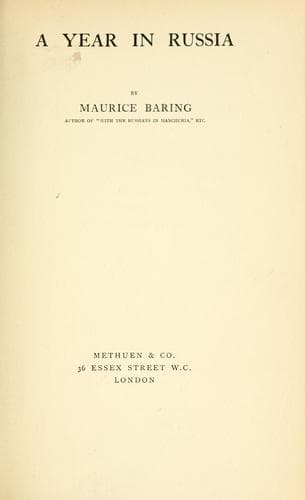
Russia -- History -- Revolution, 1905-1907; Russia -- Politics and government -- 1894-1917; Russia -- Social conditions -- 1801-1917
young generation in Russia.
_May 11th._
Two men asked me for some money in the street this morning because they
had been drunk yesterday. I went to the soldiers’ hospital in the
afternoon, and was much struck by the way in which the soldiers talked
of the Duma. These men, during the epoch which had followed the
“Manifesto,” had been violently against what they called the “Strikers.”
They had told me that when the procession attending Bauman’s funeral had
passed the windows of their hospital they would have liked to have shot
the dogs. Now they say that they understand that had there been no
strike there would have been no Duma, and that on the Duma everything
depended. One man asked me how long the Duma would last and when the
first Parliament was made in England. One of the soldiers asked me for
books the other day, and I bought him several of Scott’s novels. He was
so delighted with “Quentin Durward” that the nurse told me he read all
day and would not leave his book for a moment. He told me the whole
story of “Quentin Durward” with the various conversations between the
characters.
CHAPTER XVII
THE OPENING OF THE DUMA
ST. PETERSBURG, _May 14th_.
I had the good fortune to gain admission to the Duma yesterday
afternoon. I think it is the most interesting sight I have ever seen.
When you arrive at the Tauris Palace, which outside has an appearance of
dignified stateliness, the stateliness of the end of the Eighteenth
Century, you walk through a spacious front hall into what looks like a
gigantic white ball-room built in the late Louis XVI. style. This is the
lobby; beyond it is the Hall of the Duma itself. In this long gallery
members and visitors were already flocking, walking up and down,
talking, and smoking cigarettes and throwing away the ashes and the ends
on the polished floor. One saw peasants in their long black coats, some
of them wearing military medals and crosses; popes, Tartars, Poles, men
in every kind of dress except uniform. When the sitting began I went up
into the gallery. The Hall of the Duma itself is likewise white,
delicate in decoration, an essentially gentlemanlike room. The sitting
began about three o’clock. The members go to their appointed places, on
which their cards are fixed, and the impression of diversity of dress
and type becomes still stronger and more picturesque.
Public-domain text, read in full here on John Shaqi.
Reviews
Reviews
No reviews yet
Be the first to share your thoughts on this work.
Elsewhere in the archive
Join the Discussion
Join the discussion
Sign in to leave a comment or review.
Sign InorCreate an account