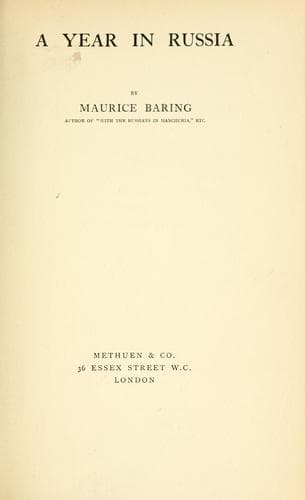
Russia -- History -- Revolution, 1905-1907; Russia -- Politics and government -- 1894-1917; Russia -- Social conditions -- 1801-1917
Many of the small groups where the discussion was being carried on were
interesting. One heard violent ideas and wild words being bandied about.
One peasant said to a friend of mine: “When I look upon this palace my
blood boils; it was built out of the blood and the sweat of the poor.”
So it was. “Then you are a person who nurses hatred?” said my friend.
“Yes,” he answered. “I hate, hate, hate the rich!” Another man told a
lady of my acquaintance that he was a Socialist. She asked him if he was
in favour of the land being made over to the State. He said, “No.” He
explained his views, which were really rather those of an extreme
Radical than of a Socialist, clearly and with intelligence, and at the
end she said to him, “But you are not a Socialist?” “Yes, I am,” he
answered; and asked her who she was. She said that she was the daughter
of a Count who is a member of the Duma. “I am very pleased to have
spoken with a Countess,” he answered, perfectly simply. I saw a big
landed proprietor, he came up to me and said, “This is very amusing for
you; but to me it is life and death.” After the interval the sitting was
continued. At 6.45 p.m. the result of the election of the thirty-three
members was read out, and Professor Kovolievski’s motion was debated
shortly and rejected. After this the question of closure was discussed
and referred to a committee. Then I left. The sitting came to an end
shortly afterwards.
My impression of the whole is that the Duma is far more moderate than I
expected. I do not think, and I never have thought, that the Cadet
leaders are a set of unpractical idealists or terrorists in disguise.
Both these ideas seem to me both to be _a priori_ absurd, and to be
confuted by the facts. Supposing England had been governed for years
solely by the permanent officials without any control whatsoever—and the
only difference that I have ever seen between Russian officials and
those of England or any other country is that the Russian officials are
uncontrolled, and those of other countries are not—supposing that there
were in England a large party headed, let us say, by men such as Mr.
Haldane, Mr. Asquith, Mr. Birrell, Mr. Balfour, Mr. Keir Hardie, Lord
Wemyss, and Lord Percy—I mix up Liberals and Conservatives on purpose,
because if in England there were an autocracy, it is probable that all
our Statesmen, whether Liberal or Conservative, would be on the side of
the opposition—would not the officials and all their supporters with one
voice say that these men were not practical men? The Cadets are not
idealist professors or men of letters or philosophers. They are educated
men, some of them learned and experienced lawyers, some of them acute
men of business, who in any other country would unquestionably play a
part in the government of their country. In Russia (if they have not
been lawyers) they have been of necessity professors—if they have wished
to play any part in public life save that of an official—because no
Public-domain text, read in full here on John Shaqi.
Reviews
Reviews
No reviews yet
Be the first to share your thoughts on this work.
Elsewhere in the archive
Join the Discussion
Join the discussion
Sign in to leave a comment or review.
Sign InorCreate an account