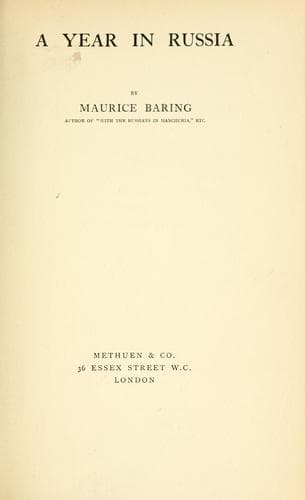
Russia -- History -- Revolution, 1905-1907; Russia -- Politics and government -- 1894-1917; Russia -- Social conditions -- 1801-1917
Last night the second reading of the Address in reply to the Speech from
the Throne was passed by the Duma. What will be the attitude of the
Government with regard to the demands which have been formulated? As far
as I have been able to gauge it, the attitude of the supporters of the
Government and of the more Conservative element in the Council of Empire
is this: they say the demands of the Duma are impossible; that the Duma
is not a representative Duma; that no notice must be paid to its
extravagant and foolish talk; that it must be allowed to talk on, and
that Russia will then see that its demands are preposterous. This I
believe to be the attitude of the Government. In support of its
contention that the Duma is not representative, it alleges that Count
Witte is to blame in having insisted on suffrage by three degrees. Had
there been universal suffrage, they add, the Duma would have been more
Conservative. The day before yesterday I attended the sitting of the
Council of Empire, and during the interval I had some conversation with
some of the members, and these were the kind of things I heard. Then I
went to the Duma and I talked to the peasants. I asked one of them if he
thought it was true that the Duma was not representative and whether the
opinions it expressed were a faithful reflection of the opinion of the
country. He said that the opinion in the country was far stronger than
anything which had been expressed in the Duma. I believe that he was
perfectly right. One can only judge by one’s personal experience, and
wherever I have been during the last month I have found the feeling
among the people dangerously tense and inexpressibly vehement. I said to
this peasant, who came from the Government of Archangel: “Do they expect
much of the Duma in your part of the country?” “They expect nothing at
all,” he answered, “because the Government will never give the Duma what
it wants, and we shall have to disperse.” “And then?” I asked. “Then we
shall take what we want,” he said very calmly. “There has always been a
wall of bureaucracy between us and the Emperor,” he continued, “and that
wall is still there.” Talking to other members I found that they were
just as little illusioned with regard to the attitude of the Government
as the peasant from Archangel. One of them said to me: “Yes; it means
there will be a conflict.” Another said: “There is no connecting link
between us and the Emperor. We must have a responsible Ministry, and it
is on that point that the struggle will be centred.” Another peasant
said to me: “We are not opposed to having two Houses; but we are opposed
to the Council of Empire as it now stands, because half of it consists
of the same Bureaucrats who have been the cause of all our trouble.”
Public-domain text, read in full here on John Shaqi.
Reviews
Reviews
No reviews yet
Be the first to share your thoughts on this work.
Elsewhere in the archive
Join the Discussion
Join the discussion
Sign in to leave a comment or review.
Sign InorCreate an account