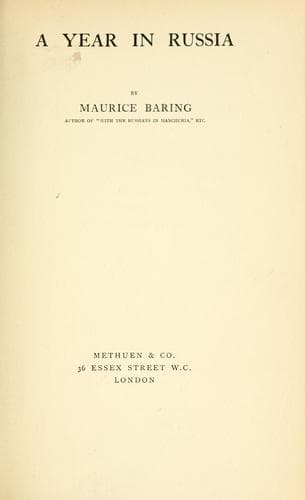
Russia -- History -- Revolution, 1905-1907; Russia -- Politics and government -- 1894-1917; Russia -- Social conditions -- 1801-1917
Every time I pay a fresh visit to the Duma I am struck by the
originality of the appearance of its members. There is a Polish member
who is dressed in light blue tights, a short Eton jacket and Hessian
boots. He has curly hair, and looks exactly like the hero of the
“Cavalleria Rusticana.” There is a Polish member who is dressed in a
long white flannel coat reaching to his knees, adorned with an intricate
pattern of dark crimson braid, and he also wears a long, soft, brown
sleeveless cloak hanging from his shoulders, bordered with vermilion
stripes. There are some Socialists who wear no collars, and there is, of
course, every kind of head-dress you can conceive. The second, and what
is to me the principal impression of the Duma, is the familiar ease with
which the members speak; some of them speak well, and some of them speak
badly, but they all speak as if they had spoken in Parliament all their
lives, without the slightest evidence of nervousness or shyness. The
sittings of the Duma are like a meeting of acquaintances in a club or a
_café_. There is nothing formal about them. The member walks up to the
tribune and sometimes has a short conversation with the President before
beginning his speech. Sometimes when he is called to order he indulges
in a brief explanation. The last sitting I attended they did their work
in a most business-like manner and got through it fairly quickly and
without many speeches. The peasants think there is too much speaking
altogether. One of them said to me, “There are people here who have no
right to be here.” “Who?” I asked. “Popes, for instance,” he said. “Why
shouldn’t Popes be members?” I asked. “Because they get 200 roubles a
year,” he answered; “what more can they want?” If this principle were
carried out in England there would be no members of Parliament at all.
Nobody can possibly say the Duma is disorderly; it takes itself with
profound seriousness. Only one person has made a joke so far. But there
have been many dramatic moments; for instance, when the President
announced that he was not to be received by the Emperor, and when for
the first time, in breathless silence, one of the Under Ministers spoke
from the Ministerial Bench. The beauty of the hall in which the members
sit is increased by its outlook, for the windows form a semicircle
behind the President’s chair and they look out on a sheet of water and
trees; a kind of Watteau-Versailles landscape where _fêtes galantes_
were once probably held. Two peasants cross-questioned me narrowly the
other day about England and English Parliamentary institutions. They
asked me if there was an income tax in England, what sort of education I
had received, what was the state of agriculture in England, what was the
rotation of the crops (to which question I gave a vaguely complicated
answer), and how long the House of Commons had existed.
Public-domain text, read in full here on John Shaqi.
Reviews
Reviews
No reviews yet
Be the first to share your thoughts on this work.
Elsewhere in the archive
Join the Discussion
Join the discussion
Sign in to leave a comment or review.
Sign InorCreate an account