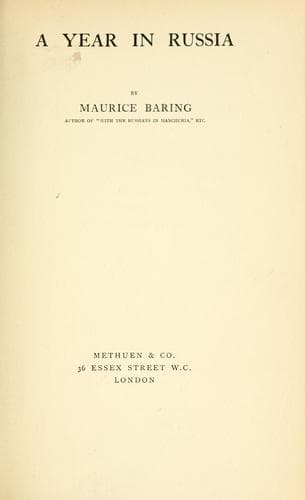
Russia -- History -- Revolution, 1905-1907; Russia -- Politics and government -- 1894-1917; Russia -- Social conditions -- 1801-1917
Together with the Cadets there is another small party who vote with the
Cadets, called the Party of Democratic Reform; it contains two of the
most capable men of the Duma. Professor Kovolievski: A scholar and an
unrivalled authority on Parliamentary traditions. An eloquent speaker,
who by the charm of his personality has become the most popular member
of the Duma. M. B. V. Kousmin Karavaieff: A Zemstvoist, educated at the
Academy of Military Law, at which he afterwards became a professor,
until he was obliged to resign in 1904. At the request of General
Kouropatkin he went to the war, where he held a responsible position; he
is one of the best, if not the best, speaker in the Duma; quiet,
persuasive, logical, and eloquent. Prince Urussoff, formerly employed in
the Ministry of the Interior, also belongs to this party.
On the left is the Labour Party. M. Anikin: A village teacher; a social
revolutionary, opposed to violence; he speaks eloquently. The abilities
of this party seem to me entirely destructive and in no way
constructive. M. Zhilkin: A peasant by extraction; subsequently a
journalist; a tall man with big features, light hair, and spectacles.
The tactical leader of his group. He speaks well and clearly. M. Aladin:
Of peasant extraction, but educated at the University of Kazan, who
emigrated to England. A violent and talented speaker; too violent to
have influence in the Duma. His speeches are sometimes interrupted by
cries of “Enough.” One of the most interesting revolutionary figures.
The peasants either belong to no party at all or to the Labour Party.
Those who belong to no party consider the Labour Party to be foolish.
One of them said to me that they were anxious to meet the proprietors
halfway, but the Government thwarted them by being so uncompromising. A
great many of these peasants are exceedingly sensible. The Labour Party
is utterly and fundamentally opposed to the Cadets, whom it despises.
The situation of the Duma as regards the Government, by which it is
practically ignored, continues to be abnormal; for this reason, and
owing to the fact that any active move on the part of the Government
unites the whole Duma in unanimity against it, the creation of further
parties is rendered difficult. The level of speaking in the Duma is
high; a competent English Judge here says it is considerably higher than
the English level. Time has certainly been wasted in talk; but the
Right, and neither the Cadets nor the Labour Party, have been to blame
for this, and also the abnormal situation of the Duma.
Public-domain text, read in full here on John Shaqi.
Reviews
Reviews
No reviews yet
Be the first to share your thoughts on this work.
Elsewhere in the archive
Join the Discussion
Join the discussion
Sign in to leave a comment or review.
Sign InorCreate an account