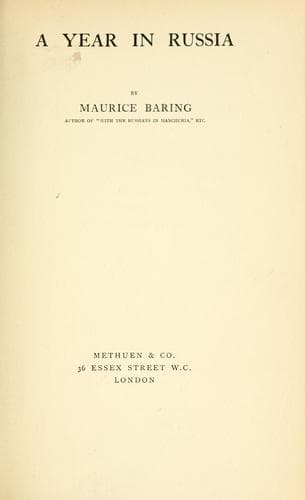
Russia -- History -- Revolution, 1905-1907; Russia -- Politics and government -- 1894-1917; Russia -- Social conditions -- 1801-1917
Whatever gets the upper hand in Russia, be it a convention, a board of
Socialists, or a committee of peasants, I am convinced of one thing,
that the members of this Government will never dress for dinner when
they feel disinclined or go to bed before they wish to do so.” “But,”
said the philosopher, “if you possess personal liberty why bother about
the rest? After all, free political institutions presuppose a certain
amount of order and discipline. If you are without this order and
discipline, and if you do not wish for the drawbacks of order and
discipline, why do you make a fuss to get what can only exist by order
and discipline?”
“If we had been properly governed,” said the ex-official, “nobody would
have thought about it.”
“The two things are not incompatible,” said the man who belonged to no
Party. “You can have free political institutions sufficiently ordered
and disciplined, and you can also have personal liberty. If these two
things have never been combined before, we will be the first people to
combine them.”
ST. PETERSBURG, _June 19th_.
On Sunday last I went by train to a place called Terrioki, in Finland,
where a meeting was to be held by the Labour Party of the Duma. The
train was crowded with people who looked more like holiday-makers than
political supporters of the Extreme Left—so crowded that one had to
stand up on the platform outside the carriage throughout the journey. It
is of no consequence in Russia how many people there are in a train or
what they do. In England there is an impressive warning in the railway
carriages about being fined a sum not exceeding forty shillings. In
Russia there is also a quantity of printed rules. The difference is
this—in England, if you infringed the rules, something would be sure to
happen. In Russia nobody pays the slightest attention to any rule and
nothing happens. You are not fined a sum not exceeding forty shillings;
on the other hand, a young man not long ago, owing to the habit he had
acquired—a habit universally practised by passengers on the line—of
jumping out of the train long before it had reached the station, slipped
on the step, and was nearly killed. This is a small instance of what
people mean when they allude to the personal liberty prevalent in
Russia. It is also an explanation of the existence of the quantity of
printed regulations you see in Russia. The authorities print a hundred
rules in the hope that one of them may meet with attention. None of them
commands attention. I will give another small instance. If a stranger to
Europe came to Europe and to England and tried to get into the House of
Commons without a ticket and without being acquainted with a member, he
would find it, I think, impossible to obtain admittance. If he went to
Russia he could, if he said nothing at all, walk into the Duma without
the slightest difficulty. The whole secret of avoiding bothers in Russia
Public-domain text, read in full here on John Shaqi.
Reviews
Reviews
No reviews yet
Be the first to share your thoughts on this work.
Elsewhere in the archive
Join the Discussion
Join the discussion
Sign in to leave a comment or review.
Sign InorCreate an account