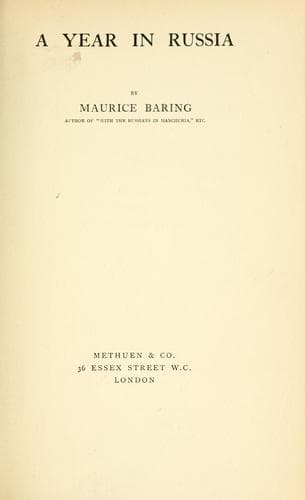
Russia -- History -- Revolution, 1905-1907; Russia -- Politics and government -- 1894-1917; Russia -- Social conditions -- 1801-1917
The meeting was opened by a man who laid stress on the necessity of a
Constituent Assembly. The speeches succeeded one another. Students
climbed up into the pine-trees and on the roof of the proscenium. Others
lay on the grass behind the crowd. “Land and Liberty” was the burden of
the speeches. There was nothing new or striking said. The hackneyed
commonplaces were rolled out one after another. Indignation, threats,
menaces, blood and thunder. And all the time the sun shone hotter and
“all Nature looked smiling and gay.” The audience applauded, but no
fierceness of invective, no torrent of rhetoric managed to make the
meeting a serious one. Nature is stronger than speeches, and sunshine
more potent than rant. It is true the audience were enjoying themselves;
but they were enjoying the outing, and the speeches were an agreeable
incidental accompaniment; they enjoyed the attacks on the powers that
be, as the Bank-holiday maker enjoys Aunt Sally at the seaside. Some
Finns spoke in Russian and Finnish, and then M. Aladin, the prominent
member of the Duma, made a real speech. As he rose he met with an
ovation. M. Aladin is of peasant extraction. He passed through the
University in Russia, emigrated to London, was a dock labourer, a
printer’s devil, a journalist, an electrical engineer, a teacher of
Russian; he speaks French and German perfectly, and English so well that
he speaks Russian with a London accent. M. Aladin has, as I have said, a
great contempt for the methods of the Russian revolutionaries, and he
expressed something of it on this occasion. He said that only people
without any stuff in them would demand a Constituent Assembly. “You
don’t demand a Constituent Assembly, you constitute it,” he said. “It
was humiliating,” he continued, “that citizens of a big country like
Russia should be obliged to come to Finland in order to speak their
minds freely. It was time to cease being a people of slaves, and time to
be a revolutionary people. The Russian people would never be free until
they showed by their acts that they meant to be free.” M. Aladin speaks
without any gesticulation. He is a dark, shortish man, with a small
moustache and grey serious eyes, short hair, and a great command of
incisive mordant language. His oratory is, as I have said before,
English in style. On this occasion it was particularly nervous and
pithy. He did not, however, succeed in turning that audience of
holiday-makers into a revolutionary meeting. The inhabitants of the
villas clapped. The young ladies in large hats chortled with delight. It
was a glorious picnic; an ecstatic game of Aunt Sally. And when the
interval came the public rushed to the restaurants. There was one on the
sea-shore, with a military band playing. There was a beach and a pier
and boats and bathers. Here was the true inwardness of the meeting. Many
people remained on the beach for the rest of the afternoon. The Social
Democrats who had been present were displeased with M. Aladin’s speech.
Public-domain text, read in full here on John Shaqi.
Reviews
Reviews
No reviews yet
Be the first to share your thoughts on this work.
Elsewhere in the archive
Join the Discussion
Join the discussion
Sign in to leave a comment or review.
Sign InorCreate an account