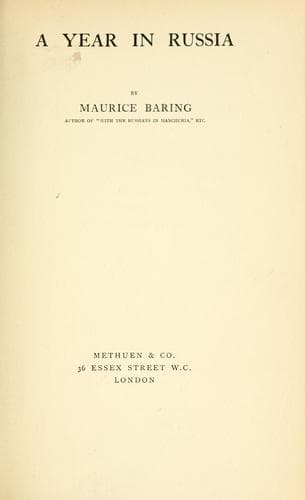
Russia -- History -- Revolution, 1905-1907; Russia -- Politics and government -- 1894-1917; Russia -- Social conditions -- 1801-1917
I went to see Nazarenko in his house. He was not at home, but a friend
of his was there. He told me to wait. He was a peasant thirty-nine years
old, rather bald, with a nice intelligent face. At first he took no
notice of me, and read aloud to himself out of a book. Then he suddenly
turned to me and asked me who I was. I said I was an English
correspondent. He got up, shut the door, and begged me to stay. “Do the
English know the condition of the Russian peasantry?” he asked. “They
think we are wolves and bears. Do I look like a wolf? Please say I am
not a wolf.” Then he ordered some tea and got a bottle of beer. He asked
me to tell him how labourers lived in England, what their houses were
made of, what the floors and walls were made of, how much wages a
labourer received, what was the price of meat, whether they ate meat?
Then he suddenly, to my intense astonishment, put the following question
to me: “In England do they think that Jesus Christ was a God or only a
great man?” I asked him what he thought. He said he thought He was a
great man. He said that the Russian people were very religious and
superstitious; they were deceived by the priests, who threatened them
with damnation. He asked me if I could lend him an English bible. He
wanted to see if it was the same as a Russian bible. I said it was
exactly the same. He was immensely astonished. “Do you mean to say,” he
asked, “that there are all those stories about Jonah and the whale and
Joshua and the moon?” I said “Yes.” “I thought,” he said, “those had
been put in for us.” I tried to explain to him that we were taught
almost exactly the same doctrines, the differences between the Anglican
and the Orthodox Church on points of dogma being infinitesimal. We then
talked of ghosts. He asked me if I believed in ghosts. I said I did; he
asked why. I gave various reasons. He said he could believe in a kind of
telepathy, a kind of moral wireless telegraphy; but ghosts were the
invention of old women. He suddenly asked me whether the earth was four
thousand years old. “Of course it’s older,” he said. “But that’s what we
are taught. We are taught nothing about geography and geology. It is, of
course, a fact that there is no such thing as God,” he said; “because,
if there is a God He must be a just God; and as there is so much
injustice in the world it is plain that a just God does not exist.” I
said I could conceive there being an unjust God. Such an idea was
inconceivable, he said. “But you,” he went on, “an Englishman who has
never been deceived by officials, do you believe that God exists?” (He
thought that all ideas of religion and God as taught to the Russian
people were part of a great official lie.) “I do,” I said. “Why?” he
asked. I asked him if he had read the book of Job. He said he had. I
said that when Job has everything taken away from him, although he has
done no wrong, suddenly in the very depth of his misery he recognises
Public-domain text, read in full here on John Shaqi.
Reviews
Reviews
No reviews yet
Be the first to share your thoughts on this work.
Elsewhere in the archive
Join the Discussion
Join the discussion
Sign in to leave a comment or review.
Sign InorCreate an account