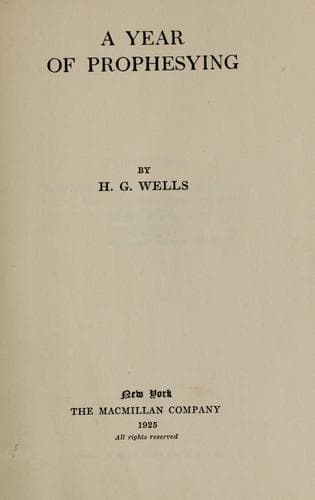
A year of prophesyingWells, H. G. (Herbert George)
History
A year of prophesying
Wells, H. G. (Herbert George)
Civilization, Modern -- 20th century; Europe -- History -- 20th century; Great Britain -- History -- 20th century
As spokesman for your English-speaking readers, it is natural for
me to dwell upon the ease with which you wear an English costume.
In many respects you are intensely French: French after the manner
of the greatness of France, the France of liberty, equality, and
world fraternity. But you transcend all narrow and nationalist
limitations. In the past, before the great wars of the Napoleonic
period, the English and French had not that sense of difference,
that disposition to antagonistic contrasts, too frequently evident
to-day. Intellectually our communities were more closely interwoven.
Men remembered then how the Normans linked us; how Burgundian and
Englishman were sturdy allies; how Briton and Breton had a common past,
and how close were Frank and Fleming to the Anglo-Saxon stock. We
Normans and Saxons and Franks and Flemings and Scots and Burgundians
and Gascons and Angevins built our Gothic cathedrals in brotherly
competition, and our knights and bowmen and princes and bishops
bickered and went to and fro. Our literatures sprang from common
roots and intertwined, and were continually grafted and regrafted one
upon the other. No Englishman finds anything essentially foreign
in Rabelais and Montaigne; they are in the same company as Swift
and Sterne, as to-day Voltaire almost lives again in Shaw. Such
contemporary English writers as Belloc and Chesterton would be seen
plainly for Frenchmen if they wrote in French. And we do not find in
you anything foreign to our spirit and our humour. Our response to you
is a kindred response. You probably have far more imitators in Britain
and America than you have in all the Latin countries of the world.
Some of the most promising of the newer American writers are clearly
indebted to you. There are many of us writers of English--and some of
these not the least among us--to whom it would be the sweetest praise
to be likened to Anatole France. In the end it may be found that you
have exerted an influence upon our English literature even greater
than that influence upon your own. We are not intruders, therefore,
not foreign admirers and outsiders, at these birthday celebrations. We
English writers are here of right, and because we are akin to you and
within the realm of your thought and power.
XXXIII
THE EUROPEAN KALEIDOSCOPE: THE GERMAN WILL IN DEFAULT
23.4.24
I was in Paris the other day when M. Poincaré reconstructed his
Government, and I heard him make his declaration of policy to the
Chamber of Deputies. I had never seen him before. It was a dramatic and
amusing occasion, and I conceived for M. Poincaré the same sort of warm
and hostile affection that I have for Mr. Winston Churchill and Mr.
Lloyd George. He is an entirely delightful personality; he has all the
charm--and much of the appearance--of a wiry-haired terrier. He even
barks.
Public-domain text, read in full here on John Shaqi.
Reviews
Reviews
No reviews yet
Be the first to share your thoughts on this work.
Elsewhere in the archive
Join the Discussion
Join the discussion
Sign in to leave a comment or review.
Sign InorCreate an account