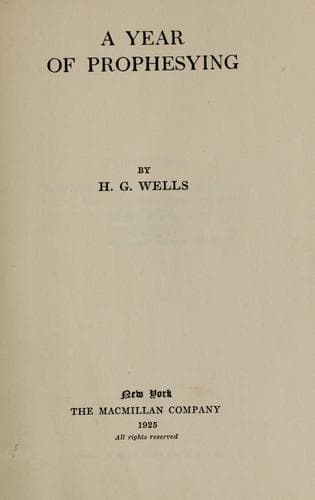
A year of prophesyingWells, H. G. (Herbert George)
History
A year of prophesying
Wells, H. G. (Herbert George)
Civilization, Modern -- 20th century; Europe -- History -- 20th century; Great Britain -- History -- 20th century
China drove the Huns westward to relieve Europe from the decaying
stagnation of the western Roman Empire. She gave the world paper,
which made the printed book and newspaper possible, which made general
education and the publication of scientific work possible, which indeed
laid the foundation of the modern world. She taught the Mongols and
Turks the organisation and military methods that ended the dying Greek
impulse of the eastern Roman Empire, nearly conquered Europe, and drove
the reluctant European seamen to discover South Africa and America. She
numbers to-day more than a fifth part of the human race; has four times
as many civilised citizens as the United States, and nearly as many as
all continental Europe put together. When we discuss the struggles of
a world civilisation to exist it is well now and then to give China
a thought. For China must be a pillar of that world civilisation
equivalent to the whole English-speaking world.
Two or three facts of some importance are not perhaps so actively
present in the general consciousness as they might be. There is a
Chinese Republic with a President in Pekin, who rules more or less
in most of China proper, though Canton and several other provinces
get along in a state of provisional independence. But besides the
President there is also a young Emperor in Pekin with a large official
income--in arrears--and a remarkable English tutor. The Emperor, we are
told, is quite Anglicised, he is being taught constitutional history,
and presently, if the British people do not wake up to the dangers of
the position, there may be an attempt, open or furtive, with British
assistance, to restore the Chinese monarchy. Moreover, although I
understood at the Washington Conference that Wei-hai-wei was to be
given up, the British are still there--waiting for something to turn
up. The British never had much right to be in Wei-hai-wei; their excuse
for being there collapsed with the collapse of Russian imperialism;
and probably not one British voter in the hundred is prepared for the
possibly expensive and humiliating consequences of keeping there too
long. The abandonment of the Singapore dock enlargement implied a
policy of general withdrawal from forcible adventures in Eastern Asia.
But in the untidy way of the British, the shreds and patches of some
old dream of a military and political predominance in China are left
to brew misunderstandings and trouble in the future.
Public-domain text, read in full here on John Shaqi.
Reviews
Reviews
No reviews yet
Be the first to share your thoughts on this work.
Elsewhere in the archive
Join the Discussion
Join the discussion
Sign in to leave a comment or review.
Sign InorCreate an account