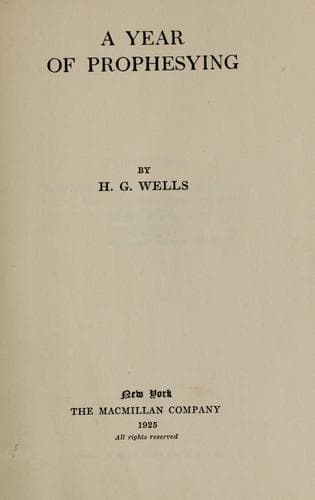
A year of prophesyingWells, H. G. (Herbert George)
History
A year of prophesying
Wells, H. G. (Herbert George)
Civilization, Modern -- 20th century; Europe -- History -- 20th century; Great Britain -- History -- 20th century
Before the heavy transport aeroplane can be safely used its mechanics
must be insured against attack from fighting aeroplanes in the hands
of highly skilled men. And this brings us to the essential objection
to any panic creation of air forces. In the air quality is of supreme
importance, and quality is rare. Given equal machines a good man can
almost always put down a mediocre man; a man of exceptional gifts can
keep on putting down ordinary men. The star air fighters in the war
were men who had accounted for scores of enemy machines. Given a few
exceptional men and the best machines, an air force of a few score
units is capable of accounting for hundreds of inferior squadrons.
God, we are told, is on the side of the biggest battalions, but this
arithmetical preference, if it continues at all at the present time,
is certainly restricted only to land fighting. In the air God is now
manifestly on the side of intelligence, quickness, and courage. For
a mastery of the air over and around one’s country there is needed
therefore, before all other things, a War Office capable of finding and
using first-class men, aviators, mechanics and inventors. Inventors and
innovators most of all. After that, it must have money for the best
material. But the money and the bulk of the product is a secondary
matter. It is only after the air war is won that the big omnibuses full
of bombs can come into play for more than incidental raids.
Now it is doubtful if any War Office exists or can exist capable of
carrying on a skilled air warfare. There is something subtly stupid
and unscientific about this war business, and you will never find
first-class imaginations giving themselves freely and continuously
to war organisation. Great men like Cromwell or Mr. Trotsky may do
miracles of war organisation under necessity, but it is only puerile
types like Mr. Amery who can go on planning war in peace time. The
soldier is, has been, and always will be a rather limited and usually
a rather thickheaded person. It follows therefore that if ever there
should be a real, fully-prepared-for war in the world again--a thing
which, as the unrepentant author of the phrase “The War to End War,”
I am naturally disposed to doubt--then probably the air warfare which
will dominate it will be a warfare conducted with machines far below
the quality of the best contemporary knowledge, and by men below
the highest attainable standard. It may be, therefore, a clumsy
war, as needlessly destructive as the great war; and the lumbering
big aeroplane, with its tons of explosive, in search for targets of
military significance, will incidentally smash up all sorts of precious
things. But the less clumsy air-warfare is the less it will do that.
It is a paradoxical-looking but quite valid proposition that the
less we develop special skill and invention in air-warfare the more
prolonged and destructive air-warfare is likely to be. A brilliantly
Public-domain text, read in full here on John Shaqi.
Reviews
Reviews
No reviews yet
Be the first to share your thoughts on this work.
Elsewhere in the archive
Join the Discussion
Join the discussion
Sign in to leave a comment or review.
Sign InorCreate an account