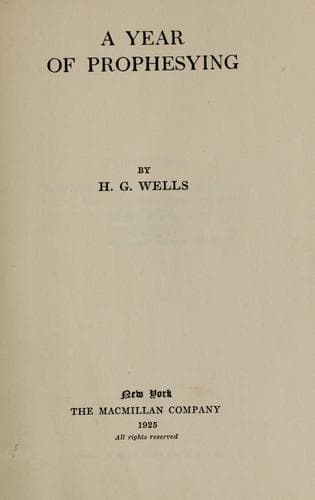
A year of prophesyingWells, H. G. (Herbert George)
History
A year of prophesying
Wells, H. G. (Herbert George)
Civilization, Modern -- 20th century; Europe -- History -- 20th century; Great Britain -- History -- 20th century
The Government and the local authorities are to pay about half the
cost of building a multitude of houses, the assistance being given on
the sole condition that they fall below a certain standard of size and
comfort, and the industrial employer will be able to pay low wages
in proportion to the cheapness attained. In other words, the Labour
Government is doing a deal with the building trade in the interest of
the low-grade employer and is putting British industry “on the rates.”
They are returning by a circuitous route to the condition of things in
England before the New Poor Law, when farmers grew rich by employing
labour in receipt of outdoor relief, at otherwise impossibly low wages.
The most striking thing about these housing proposals is the tacit
acceptance by all parties in Parliament that the population of the
coming years must be put away, each family in a little separate house
of its own. If anything was needed to prove that the Socialism of
the Labour Party was merely skin deep and its creative intentions
an electioneering bid, it would be this. If one thing is clearer
than another in the outlook of the modern community, it is the
impossibility of the small separate house. It is a cage of needless
toil for women; it is a place of deprivation and hardship for children.
The whole drift of things is in favour of the highly organised block
building containing a great number of houses. In this there can be
electric light, radiators, a supply of hot and cold water, efficient
sanitary accommodation, group wash-houses, adequate cupboards, and
convenient shopping facilities, all provided at a less cost than is
needed for the same number of scattered low-grade homes, each under its
separate roof, with lamps to clean, fires to light, water to boil, and
every possible demand for feminine drudgery and servitude.
In their dreams people think of Mr. Wheatley’s projected houses as
little flower-girdled cottages, each with a bright little garden and a
drying-ground and an uncontrolled multitude of children playing in the
sun; in reality we shall get rows and rows of mean little boxes on the
outskirts of our towns, jammed together into slums, each fouling the
air with a separate chimney, and remote from every modern amenity.
Public-domain text, read in full here on John Shaqi.
Reviews
Reviews
No reviews yet
Be the first to share your thoughts on this work.
Elsewhere in the archive
Join the Discussion
Join the discussion
Sign in to leave a comment or review.
Sign InorCreate an account