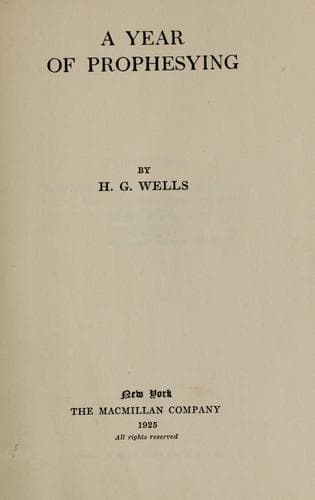
A year of prophesyingWells, H. G. (Herbert George)
History
A year of prophesying
Wells, H. G. (Herbert George)
Civilization, Modern -- 20th century; Europe -- History -- 20th century; Great Britain -- History -- 20th century
One of the most remarkable aspects of this housing legislation is
the ineffectiveness of the women. When women were struggling for the
vote the world was given to understand that their success would be an
end to “man-made laws” and “man-made” ways of living. There was to
be an astonishing release of the sensible, practical feminine mind.
Well, here is a question that concerns women primarily. A very large
proportion of the girls and women of to-day, before their lives are
out, will have to live either in the slums that the Labour Government
is failing to reorganise, or in the rows and clumps of boxes of brick
or timber that are to be spread out over the outskirts of every centre
of population. There was nothing to prevent the distinguished women of
the Labour Party from giving these men who are framing-up these schemes
to build pauper houses and endow the building trade at the public
expense a lead towards better things. These houses of the Wheatley
project mean an effectual subjugation of great multitudes of women to
dingy drudgery for scores of years to come; they mean the growth of
a new generation of children with miserable standards of comfort and
freedom. But so far we have had no guidance from intelligent women at
all, but only speeches from such mere party supporters as Dr. Marion
Phillips sustaining the preposterous pretensions of Mr. Wheatley. The
Women’s Housing Councils’ National Federation, with its resolutions
for the glorification of Mr. Wheatley’s building ramp, does no more
than emphasise the general feminine apathy. Generally, the women of
the country seem not to be awake to the manner in which this business
concerns them.
Only one exception occurs to me at the present moment in the widespread
indifference of intelligent and influential women to the comfort and
outlook of the mass of their sex, and that is Mrs. Leonora Eyles,
the novelist. Her book, _The Woman in the Little House_, is a most
intelligent, sympathetic, and illuminating account of what it means
to live in just such little houses as Mr. Wheatley and his friends,
the employers and employed of the building trade, are conspiring to
stereotype. She describes not slum life but the life of an ordinary
working man’s wife in London, without exaggeration and without
extenuation. It is a picture of extreme dinginess and meanness,
relieved only by the pluck and devotion and hopefulness and cheerful
humour that enable these people to hang on and hope for better things.
It is this sort of life the Wheatley legislation proposes to extend and
perpetuate, because in Britain, as everywhere in the world, political
life is divorced from the creative imagination, and because the mass
of common men and women in the world do not know how much they may
reasonably ask for from those who have access to the science and
control of the resources of the world.
LI
THE TRIVIALITY OF DEMOCRACY AND THE FEMININE INFLUENCE IN POLITICS
Public-domain text, read in full here on John Shaqi.
Reviews
Reviews
No reviews yet
Be the first to share your thoughts on this work.
Elsewhere in the archive
Join the Discussion
Join the discussion
Sign in to leave a comment or review.
Sign InorCreate an account