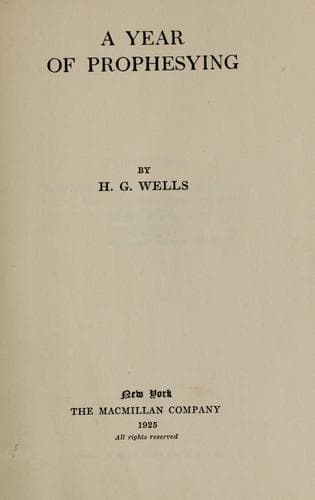
A year of prophesyingWells, H. G. (Herbert George)
History
A year of prophesying
Wells, H. G. (Herbert George)
Civilization, Modern -- 20th century; Europe -- History -- 20th century; Great Britain -- History -- 20th century
He had tried to get me talking of the extravagant horrors of the Next
Great War. I suppose he thought I should talk impossible rubbish about
bombs as big as houses and whole cities destroyed by poison gas and
so forth, and he would be able to retail this monstrous stuff half
jeeringly and half credulously. At any rate, I found myself talking
of the improbability of there ever being a war in Europe even so
mechanically destructive as the last war. The Great War had been
the explosion of a vast accumulation of energy, moral and social as
well as material. Europe might, and probably would, bicker, murder,
bomb, massacre, and starve, but for another generation at least she
would not have either the spirit or the discipline or the material
to produce such munitions and such wide-sweeping concerted action as
devastated her in the Great War. She is morally and physically bankrupt
and prostrate. She may go on sinking, as Asia Minor sank, back even
to barbarism. Even if she does not do so, it will take forty or fifty
years to reassemble energy for another such world-wide outbreak.
I went on to talk of the disappointment of the peace. Which had failed
us most, intelligence or moral force? Both had failed us. For four
years now Europe had been disintegrating. This poor League of Nations
at Geneva, snubbed and brow-beaten by the French and Italians, who
belonged to it and did not believe in it, and distrusted and hated by
the excluded Russians and Germans, seemed to confirm the futility of
any constructive effort. Things grew worse instead of better. Tariffs,
currency manipulation, the cost of armaments, were destroying urban and
industrial life under our eyes. The parasitic speculator flourished;
the peasant in his self-centred way held on; the rest faded out. If one
did not foresee another Great War one foresaw the certainty of endless
little ones.
And so talking, and perhaps a little forgetful of my hearer, sitting
almost knee to knee, intent to translate whatever he could catch of my
talk and hand it out in his own phrases and colouring, I recalled a
conversation I had had quite recently in Paris with my friend Philippe
Millet, who is now dead. We were old friends. We had talked about the
affairs of the world in Paris both before the war and during the war
and at Washington during the Conference; and even in 1921 at Washington
we could still believe that the Western world in which we were born
and by which we lived might yet make an effort sufficiently creative
and generous to save itself and develop a new and greater phase of
civilisation. I was then publicly denouncing the French for their
trust in submarines and Senegalese, but that made no difference in our
mutual good will. He understood the spirit that moved me. But this
last summer, when we met for the last time, Millet was an ailing and
disillusioned man.
Public-domain text, read in full here on John Shaqi.
Reviews
Reviews
No reviews yet
Be the first to share your thoughts on this work.
Elsewhere in the archive
Join the Discussion
Join the discussion
Sign in to leave a comment or review.
Sign InorCreate an account