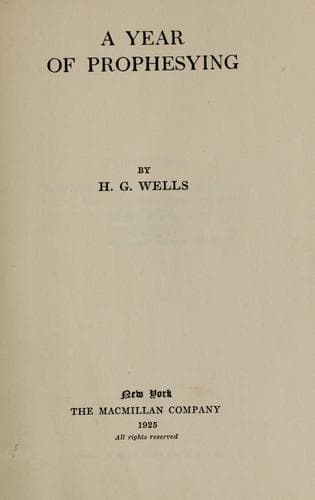
A year of prophesyingWells, H. G. (Herbert George)
History
A year of prophesying
Wells, H. G. (Herbert George)
Civilization, Modern -- 20th century; Europe -- History -- 20th century; Great Britain -- History -- 20th century
At no time in the world’s experience has the need for a creative
education been so manifest as it is to-day. This social and political
system in which we live is ailing and divided against itself, failing
to reconstitute even as much economic universalism as prevailed before
the great war, involving itself in a hopeless muddle of debts. It is
a system plainly doomed to a further series of wider and profounder
disasters, unless amidst its distresses it can evolve a clearer
realisation, not only in its ruling classes but generally, of the
origins of our race and our civilisation, of the conditions under
which our communities have grown, of the vital inter-relationships
of our social order, and of the tremendous perils and the immense
possibilities before mankind. A population with such a breadth of
outlook, a population disciplined to creative constructive work, is not
simply desirable to-day; it is imperatively demanded if civilisation
is to avert a decay and a collapse as much greater than the Decline
and Fall of the Roman Empire as a modern liner is greater than an
Alexandrian galley.
It is because of his realisation of the paramount need of a great
educational effort as the first and supreme thing in human affairs
to-day that every intelligent man must needs note with something
between dismay and bitter derision the recent signs of a revival
of “classical” teaching in the schools and colleges of the Atlantic
peoples. The French, who so love the eighteenth century that in foreign
and domestic policy they are always trying to get back to it, have led
the way. Disturbing modern subjects which tend to betray the facts
that the Mediterranean Sea is not the whole world, and that most great
events of present importance to mankind occurred before or outside of
or in revolt against the Latin civilisation, are to be kept out of
the purview of French adolescence. More Greek will be taught, but not
enough of it and not well enough for the young Frenchman to realise
how feeble was the political, social, and economic reaction of Greece
upon Rome. He will be trained to think that there was some sort of
magnificent succession between the two, whereas Rome got little from
Greece except slave pedagogues and pedants, misleading literary models
which crippled her own sturdier initiative, articles de luxe, living
and dead, architects, sculptors and painters, and cared so little for
the clarifying Aristotle that she left his books about and lost them.
Public-domain text, read in full here on John Shaqi.
Reviews
Reviews
No reviews yet
Be the first to share your thoughts on this work.
Elsewhere in the archive
Join the Discussion
Join the discussion
Sign in to leave a comment or review.
Sign InorCreate an account