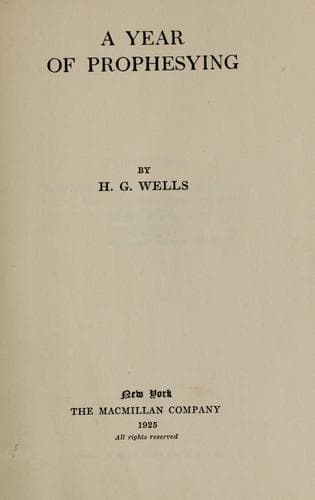
A year of prophesyingWells, H. G. (Herbert George)
History
A year of prophesying
Wells, H. G. (Herbert George)
Civilization, Modern -- 20th century; Europe -- History -- 20th century; Great Britain -- History -- 20th century
For the Communist Party which still controls Russia has this in common
with the Catholic Church, that it is sustained by a system of dogmas,
disciplines and, now, experiences and traditions so much stronger than
any single individual, that individuals, though they may serve it more
or less effectively, cannot control nor deflect it. They must move
inside its limitations. Russia, under the Communist rule, is at the
opposite pole to such a phase of affairs as would evoke a Cæsarism.
It is over the Western Latin democracies, subjected to the adventures
and ravages of uncontrolled rich men, that the dictators arise.
Lenin was never in reality a dictator as Mussolini is a dictator. He
impressed one as being in the grip of forces quite beyond his control,
albeit they are forces he had himself helped to develop and organise.
Communism is definite, directive, compelling; Fascism is dramatic
and empty, a puerile, vague, violent thing, a young ass to be ridden
anywhere by a bold, competent rider. A score of Lenins might die and
Communism would go on as though nothing had changed. Without Mussolini
the Fascisti might do anything--fall into a torrent, get lost, destroy
society, vanish.
I saw Lenin in 1920 in the Kremlin. He was an extraordinarily fragile
little thing, small hands clasped together upon the corner of his desk
and little feet that dangled from his chair far off the ground. He was
very bald. I learn now with astonishment that I was the older man.
He put his amusing Mongoloid face a little on one side as we talked,
with something of the wary expression of a fencer. When he found out
I didn’t want to score points for or against Communism, but to learn
what they proposed to do next and particularly what they proposed to do
about the peasants, he dropped any appearance of controversy and laid
his views and plans before me very frankly.
In return I tried to tell him things about England, but he seemed to
have been stuffed up with a lot of nonsense about British conditions.
He believed that a certain obscure paper called the _Dreadnought_, or
the _Woman’s Dreadnought_, or some such title, edited by Miss Sylvia
Pankhurst, represented millions of insurgent British proletarians,
and that the violent struggle then going on in Ireland was, in some
slightly obscured form, a struggle between Capitalism and Communism. It
was difficult to readjust his perspectives.
His schemes for the reorganisation of Russia seemed to me to be
right-minded, honestly conceived, and very, very artless. He had a
scheme for the “Electrification of Russia” that struck my usually quite
sufficiently imaginative mind as hopelessly impractical. It ignored
distances, and Russia is a country consisting mostly of distances.
Public-domain text, read in full here on John Shaqi.
Reviews
Reviews
No reviews yet
Be the first to share your thoughts on this work.
Elsewhere in the archive
Join the Discussion
Join the discussion
Sign in to leave a comment or review.
Sign InorCreate an account