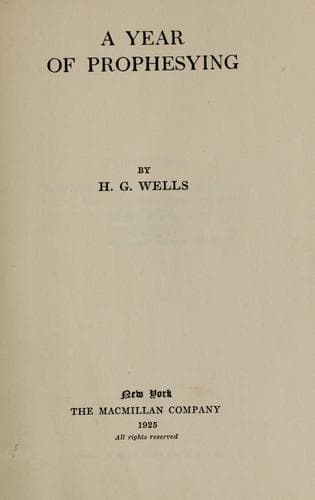
A year of prophesyingWells, H. G. (Herbert George)
History
A year of prophesying
Wells, H. G. (Herbert George)
Civilization, Modern -- 20th century; Europe -- History -- 20th century; Great Britain -- History -- 20th century
Why is this country so conspicuously poor? Why are its roads so
abominable that even between this prosperous pleasure resort of Estoril
and Lisbon, a dozen miles away, an automobile journey is a dangerous
adventure? Why are my letters and cables decaying in the Lisbon
post-office, and why does everyone say that things are going from bad
to worse, and hope for such violent remedies as a dictatorship? In no
part of Europe is the riddle of European decay posed so plainly as it
is here in this setting of windy sunshine and gay colour and natural
wealth.
The full answer to that riddle so far as it concerns Portugal would
involve a long history. But certain broad operating causes may be
noted. All Europe suffers from division, but it is in the smaller
countries that the evils of division are most apparent. The smaller
the country the nearer the Custom House and the more hampered the
trade. Lisbon might be one of the greatest ports of Europe as Beira
in Portuguese Africa might be the chief port of South Africa, but
for this, that a little way behind each is a national frontier with
a strangulating Custom House. No goods or passengers will endure the
present railway journey through Spain and Portugal if they can find
another way to the high seas. The railways are necessarily short
little railways and they are inefficient. And every sort of transport,
and indeed every concern depending upon organised labour, is further
troubled by another consequence of the sub-division of Europe. The
money is unstable. Portugal, like every proud little sovereign State,
must, of course, have its own currency. Anything else would be
unthinkable to the patriotic Portuguese. But the currency of so small
a country is at the mercy of big speculative interests abroad. The
recent postal strike turned entirely upon the readjustment of wages to
rising prices. That is the common issue in nearly all European labour
struggles now, but it produces its acutest conflicts in the weaker
countries.
The railways of Portugal are in a very bad condition and the roads are
frightful. Everywhere there are the visible evidences of incompetent or
corrupt administration. A little country like this, with an unstable
currency, cannot keep its popular education up to date; there is not a
sufficient reading public therefore to sustain an authoritative Press
and literature of political criticism. Ministers are not sufficiently
watched. And as to the things that happen in the overseas possessions
of Portugal one can hardly learn anything at all from the Portuguese
Press. No “public opinion” seems to be watching them at all. There is
a distraction of interest to other centres. Portuguese who grow rich
in the Portuguese possessions bank and invest their money abroad,
chiefly in London; there is a perpetual outgoing of this tribute from
the Portuguese empire to the stabler, greater States. Nowhere else in
Europe has one so strong a feeling of a country in pawn to capital held
abroad.
Public-domain text, read in full here on John Shaqi.
Reviews
Reviews
No reviews yet
Be the first to share your thoughts on this work.
Elsewhere in the archive
Join the Discussion
Join the discussion
Sign in to leave a comment or review.
Sign InorCreate an account