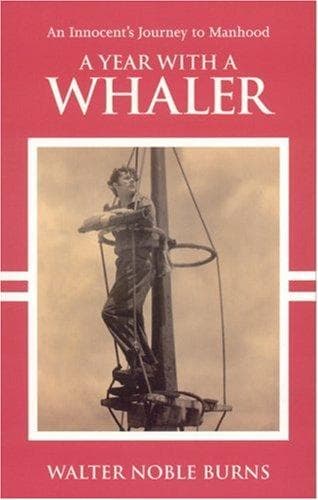
Alexander (Brig); Burns, Walter Noble, 1872-1932 -- Voyages and travels; Whalers (Persons) -- United States -- Biography; Whaling
But with the whale dead, we still had a big problem on our hands. In some
way the giant bulk had to be hauled out of the ice. This was a difficult
matter even with plenty of time in which to do it. Night was coming on and
it was the brig's custom in the hours of darkness to sail far away from
the great ice pack with its edging of floating bergs and floes in order
to avoid possible accident and to sail back to the whaling grounds on
the morrow. This Captain Shorey prepared to do now. As a solution of the
dilemma, an empty bread cask or hogshead was brought on deck and the name
of the brig was seared in its staves with a hot iron in several places.
This cask was towed to the floe, hauled up on the edge of the ice, and the
long line of one of the harpoons sticking in the whale was made fast to it
by means of staples. Thus the cask marked the floe in which the whale was
lying.
It was growing dark when the brig went about, said good-night to the
whale, and headed for open water to the south. We sailed away before a
stiff breeze and soon cask and floe and the great white continent beyond
had faded from view. When morning broke we were bowling along under light
sail in a choppy sea with nothing but water to be seen in any direction.
The great ice cap was somewhere out of sight over the world's northern
rim. Not a floe, a berg, or the smallest white chunk of ice floated
anywhere in the purple sphere of sea ringed by the wide horizon. Being a
green hand, I said to myself, "Good-bye, Mr. Whale, we certainly have seen
the last we'll ever see of you."
Let me make the situation perfectly clear. Our whale was drifting
somewhere about the Arctic Ocean embedded in an ice floe scarcely to be
distinguished from a thousand other floes except by a cask upon its margin
which at a distance of a few miles would hardly be visible through strong
marine glasses. The floe, remember, was not a stationary object whose
longitude and latitude could be reckoned certainly, but was being tossed
about by the sea and driven by the winds and ocean currents. The brig,
on the other hand, had been sailing on the wind without a set course. It
had been tacking and wearing from time to time. It, too, had felt the
compulsion of the waves and currents. So throughout the night the brig
had sailed at random and twenty miles or so away the whale in its floe had
been drifting at random. Now how were we going to find our whale again?
This struck me that morning on the open sea with neither whale nor ice in
sight, as a problem certainly very nice, if not hopeless. The way it was
solved was as pretty a feat of navigation as I ever saw.
When Captain Shorey came on deck after breakfast, he "shot the sun"
through his sextant and went below to make his calculations. In a little
while he came on deck again and stepped to the man at the wheel. The
helmsman was steering full and by.
"How do you head?" asked Captain Shorey.
"Northwest," answered the sailor.
Public-domain text, read in full here on John Shaqi.
Reviews
Reviews
No reviews yet
Be the first to share your thoughts on this work.
Elsewhere in the archive
Join the Discussion
Join the discussion
Sign in to leave a comment or review.
Sign InorCreate an account