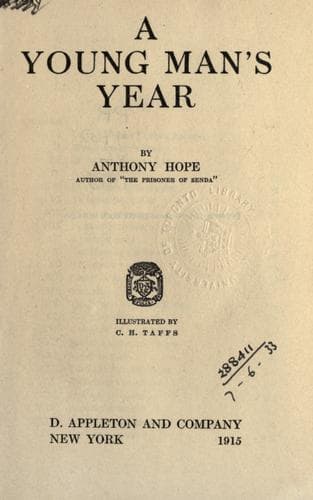
England -- Social life and customs -- Fiction; Lawyers -- Fiction; Man-woman relationships -- Fiction; Young men -- Fiction
Certainly it was very good fun--an existence full of change and
movement, richly peopled with various personalities. From the Bar they
lived rather apart, except for three or four dinner-parties, but they
entertained and were entertained by local notables. The High Sheriffs
themselves afforded piquant contrasts. Bluff and glossy Sir Quintin, the
country gentleman, was one type. Another was the self-made man, newly
rich, proud of himself, but very nervous of doing something wrong, and
with stories in his mind of judges savagely tenacious of their dignity
and free with heavy fines for any breach of etiquette: many an anxious
question from him about his lordship's likes and dislikes Arthur had to
answer. And once the office was ornamented by the son and heir of a
mighty Grandee, who did the thing most splendidly in the matter of
equipage and escort--even though his liveries were only the family's
"semi-state"--treated his lordship with a deference even beyond the
custom, and dazzled Arthur, as they waited for Mr. Justice Lance (who
was sometimes late), with easy and unaffected anecdotes of the youth of
Princes with whom he had played in childhood--the perfect man of the
Great World, with all its graces. Between this High Personage and the
man who stole the pig there ranged surely Entire Humanity!
But the most gracious impression--one that made its abiding mark on
memory--was more aloof from their work and everyday experience. It was
of an old man, tall and thin, white-haired, very courtly, yet very
simple and infinitely gentle in manner. He was an old friend of Sir
Christopher's, a famous leader of his school of thought in the Church,
and now, after long years of labour, was passing the evening of his days
in the haven of his Deanery beneath the walls of a stately Cathedral.
They spent Sunday in the city, and, after attending service, went to
lunch with him. He knew little of their work, and had never known much
of the world they moved in. But he knew the poor by his labours among
them, and the hearts of men by the strangely keen intuition of holiness.
There was no sanctimoniousness, no pursing-up of lips or turning-away of
eyes; on the contrary, a very straight dealing with facts and reality.
But all things were seen by him in a light which suffused the Universe,
in the rays of a far-off yet surely dawning splendour; Sorrow endureth
for the night, but Joy cometh in the morning.
Public-domain text, read in full here on John Shaqi.
Reviews
Reviews
No reviews yet
Be the first to share your thoughts on this work.
Elsewhere in the archive
Join the Discussion
Join the discussion
Sign in to leave a comment or review.
Sign InorCreate an account