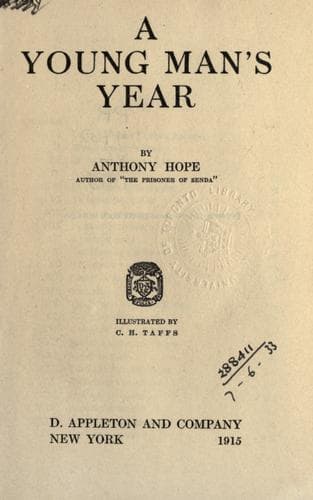
England -- Social life and customs -- Fiction; Lawyers -- Fiction; Man-woman relationships -- Fiction; Young men -- Fiction
It--that is, the case of _Crewdson v. The Great Southern Railway
Company_--was about a dog, consigned according to the plaintiff's--which
was Arthur's--contention (the real movements of the animal were wrapped
in doubt from the outset) by a certain Startin--who was at that date
butler to the plaintiff, but under notice to leave, and who did a few
days later vanish into space--to his mistress, Miss Crewdson, an elderly
lady of considerable means and of indomitable temper--from Tenterden in
Sussex to its owner at Harrogate, where she was taking the waters.
Though a very small dog, it was a very precious one, both from a
sentimental and from a pecuniary point of view. So it ought to have
been, considering the questions of law and fact which it raised! For in
reply to Miss Crewdson's simple, but determined and reiterated, demand
for her dog or her damages, the Company made answer, first, that they
had never received the dog at Tenterden, secondly that they had duly
delivered the dog at Harrogate, and lastly--but it was a "lastly"
pregnant with endless argument--that they had done all they were bound
to do in regard to the dog, whatever had in truth happened or not
happened to the animal. What actually had, nobody ever knew for certain.
A dog--some dog--got to Harrogate in the end. The Company said this was
Miss Crewdson's dog, if they had ever carried a dog of hers at all; Miss
Crewdson indignantly repudiated it. And there, in the end, the question
of fact rested--for ever unsolved. The House of Lords--though the Lord
Chancellor, basing himself on a comparison of photographs, did indulge
in an _obiter dictum_ that the Harrogate dog, if it were not the
Tenterden dog, was as like as two peas to it ("Of course it was--both
Pekinese! But it wasn't our dog," Arthur muttered indignantly)--found it
unnecessary to decide this question, in view of the fact that, Startin
having disappeared into space, there was no sufficient evidence to
justify a jury in finding that the Company had ever received any dog of
Miss Crewdson's. It was this little point of the eternally doubtful
identity of the Harrogate dog which proved such a godsend to the wits of
the Press; they suggested that the Highest Tribunal in the Land might
have taken its courage in both hands and given, at all events for what
it was worth, its opinion about the Harrogate dog. Was he Hsien-Feng, or
wasn't he? But no. The House of Lords said it was unnecessary to decide
that. It was certainly extremely difficult, and had given two juries an
immensity of trouble.
All these remarkable developments, all these delightful ramifications,
now lay within the ambit of the red tape which Arthur, left alone,
feverishly untied. He had to be at it; he could not wait. Not only was
there the conference at four-fifteen, but he was all of an itch to know
what he was in for and what he might hope for, divided between a craven
fear of difficulty above his powers and a soaring hope of opportunity
beyond his dreams.
Public-domain text, read in full here on John Shaqi.
Reviews
Reviews
No reviews yet
Be the first to share your thoughts on this work.
Elsewhere in the archive
Join the Discussion
Join the discussion
Sign in to leave a comment or review.
Sign InorCreate an account