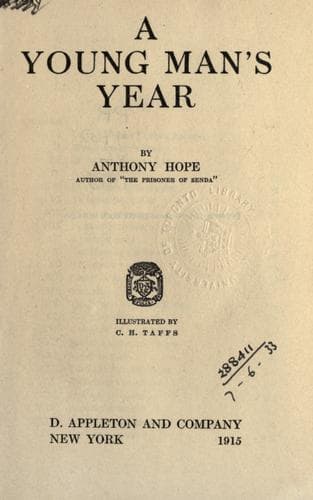
England -- Social life and customs -- Fiction; Lawyers -- Fiction; Man-woman relationships -- Fiction; Young men -- Fiction
It was not given to Arthur again to hear his mother's voice or to see
her alive. A few days after the first round of the protracted battle
over the great case had ended in his favour, just before the close of
the legal term, news reached him of her death. She had been suffering
from a chill and had taken to her bed, but no immediate danger was
anticipated. She had read with keen pleasure Arthur's letters, full now
of a new zest for his work and a new confidence. She breathed her gentle
_Nunc Dimittis_; her daughter's future was happily arranged, her son's
now opened before him. In simple and ardent faith her eyes turned to
another world. As though in answer to an appeal instinctively issuing
from her own soul, the end came very quickly. The tired heart could bear
no added strain. After making her comfortable for the night, Anna had
gone downstairs to eat her own supper; when she came up again, all was
over. There was no sign of movement, no look of shock or pain; her eyes
were closed. It seemed that sleeping she had fallen asleep, and her
peaceful spirit found in an instant the eternal peace of its faithful
aspiration.
Here was no place for the bitterness of grief. Death brought a quickened
sense of unity and love, and the lost mother joined her children's hands
in a renewal of childhood's affection and of sweet old memories. "Peace
I leave with you," Anna whispered to Arthur as they stood beside the
grave, and he felt that she divined truly the legacy which their mother
would have chosen, before all others, to bequeath to them.
It was arranged that Anna should go and stay with Ronald Slingsby's
people until the time came for her wedding; it was to take place in
about three months. The old familiar home was to be broken up. They
spent two or three busy days together, sorting out furniture, settling
what was to be sold and what either of them would like to keep;
regretfully deciding that this or that relic of old days was "rubbish"
and must be destroyed, redolent though it was with memories. Many a
sigh, many a laugh, the old things drew from them; forgotten pass-words
of childish intimacy came back to mind; ancient squabbles were recalled
with fond amusement. They lived the old days over again together. The
consciousness that the old days were finally over, that their paths in
life lay henceforth far apart, gave added tenderness to recollection,
making this good-bye to the old house and the old things a good-bye to
the old days also--even in some sense a good-bye to one another.
Public-domain text, read in full here on John Shaqi.
Reviews
Reviews
No reviews yet
Be the first to share your thoughts on this work.
Elsewhere in the archive
Join the Discussion
Join the discussion
Sign in to leave a comment or review.
Sign InorCreate an account