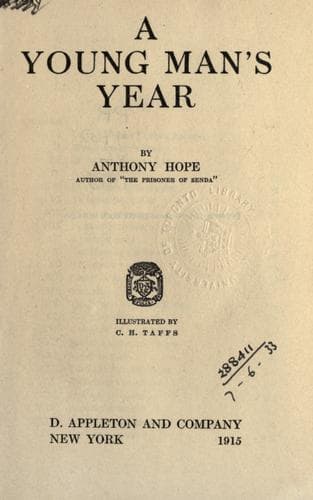
England -- Social life and customs -- Fiction; Lawyers -- Fiction; Man-woman relationships -- Fiction; Young men -- Fiction
"You're always terribly good at facing facts, Judith." He smiled. "A
little weak in the idealising faculty!"
"In this family you've supplied that deficiency--amply."
"You musn't sneer at generous emotions. It's a bad habit you've got."
She smiled, yet seemed to consider what he said. "I believe it is a bad
habit that I used to have. The old state of affairs here rather
encouraged it. So many emotions all at cross-purposes! Rather a
ridiculous waste of them! It made them seem ridiculous themselves. But I
think I've got out of the habit."
"You've still a strong bias towards the mere matter-of-fact. You like
humdrum states of mind--I believe you positively prefer them."
"And you like to pass from thrill to thrill!" She laughed. "Is that very
unfair? Because I don't mean it to be. And I am changed a little, I
think. What has happened here has made a difference. Say you think me a
little--just a little--softer?"
"Say you think me a little--just a little--harder?" he retorted, mocking
her.
"No, but seriously?" she persisted, fixing her eyes on him almost
anxiously.
"Well then, yes. I think you're perceptibly more human," he
acknowledged, laughing still.
A more serious description of the change that Arthur found in Judith
might not have gone so near the mark. Though her judgment preserved the
sanity which he admired--without emulation--and her manner the cool
satiric touch which he generally relished and sometimes resented, stress
of circumstances had broken down her detachment and forced her out of
her pose of critical but scarcely concerned spectator. She had become,
willy-nilly, involved in the family fortunes; she could no longer merely
look on, and smile, or deride; she had been forced to think, to act, and
to feel--to take a part, to shoulder her share of the load. The latent
faculties of her nature, ripe to spring into full womanhood, had
answered to the call with instinctive readiness. So soon as there was
work for her courage, her love and sympathy, she had them to give, and
the more she gave the greater grew her store. Sustaining Godfrey,
mothering Margaret, she had experienced something of the stirring and
development of feeling which comes with marriage and motherhood. Through
disaster and consolation, in ruin and the need to re-build, she had been
forced to seek the rich things of her heart and had found abundance.
Thus she seemed 'perceptibly more human,' the change of heart revealing
itself not only in her dealings with others but as surely, though more
subtly, in herself. She opened out in a new spontaneity of feeling; she
was easier to approach in confidence, more ready to appreciate and to
share the joys of the spirit. Even in her bearing and looks there might
be discerned a new alacrity, a new brightness of the eyes. Her mirth was
heartier and more kindly; her mockery had lost its bitterness without
losing its flavour.
Public-domain text, read in full here on John Shaqi.
Reviews
Reviews
No reviews yet
Be the first to share your thoughts on this work.
Elsewhere in the archive
Join the Discussion
Join the discussion
Sign in to leave a comment or review.
Sign InorCreate an account