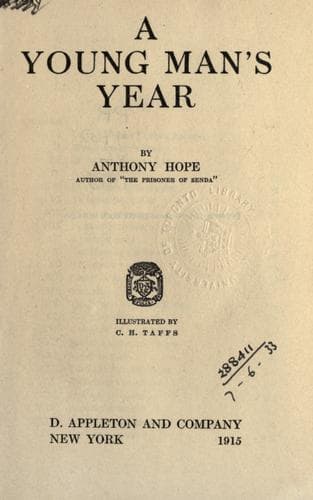
England -- Social life and customs -- Fiction; Lawyers -- Fiction; Man-woman relationships -- Fiction; Young men -- Fiction
"I suppose Canada's much like other places," said Joe, evading the
direct question. "It's my experience of business they wanted, of course,
you old fool. I'm in for a good thing this time, and no mistake! If I
hadn't had too much fizz already, I'd ask you to come and drink my
health."
"Good luck anyhow, old fellow! I'm sorry you're going away, though. I
shan't enjoy seeing Trixie Kayper half as much without you."
Joe suddenly put his arm in Arthur's. "You're a bit of a fool in some
ways, in my humble judgment," he said. "But you're a good chap, Arthur.
You stick to your pals, you don't squeal when you drop your money, and
you don't put on side. As this rotten old world goes, you're not a bad
chap."
"This sounds like a parting testimonial, Joe!"
"Well, what if it does? God knows when we shall eat a steak and drink a
pot of beer together again! A good loser makes a good winner, and you'll
be a winner yet. And damned glad I shall be to see it! Now I must
toddle--get in the Tube and go to the City. Good-bye, Arthur."
"Good-bye, Joe. I say, I'm glad we did _Did You Say Mrs.?_ Perhaps
you'll run up against Ayesha Layard over there. Give her my love."
"Oh, hang the girl! I don't want to see her! So long then, old chap!"
With a final grip he turned and walked away quickly.
Arthur saw him go with a keen pang of regret. They had tempted fortune
together, and each had liked what he found in the other. Joe's equal
mind--which smiled back when the world smiled, and, when it frowned,
thought a cheerful word of abuse notice enough to take of its
tantrums--made him a good comrade, a good stand-by; his humour, crude
though it was and pre-eminently of the market-place, put an easier face
on trying situations. He had a faithful, if critical, affection for his
friends, and Arthur was not so rich in friends as to lose the society of
one like this without sorrow. As it chanced, his intimates of school and
university days had drifted into other places and other occupations
which prevented them from being frequent companions, and he had as yet
not replaced them from the ranks of his profession, from among the men
he met in the courts and in the Temple; up to now courts and Temple had
been too much places to get away from, too little the scene of his spare
hours and his real interests, to breed intimacies, though, of course,
they had produced acquaintances. As he walked down to the Temple now,
after parting from Joe Halliday--and for how long Heaven alone could
tell!--he felt lonely and told himself that he must get to know better
the men among whom his life was cast. He found himself thinking of his
life in the Temple as something definitely settled at last, not as a
provisional sort of arrangement which might go on or, on the other hand,
might be ended any day and on any impulse. The coils of his destiny had
begun to wind about him.
Public-domain text, read in full here on John Shaqi.
Reviews
Reviews
No reviews yet
Be the first to share your thoughts on this work.
Elsewhere in the archive
Join the Discussion
Join the discussion
Sign in to leave a comment or review.
Sign InorCreate an account