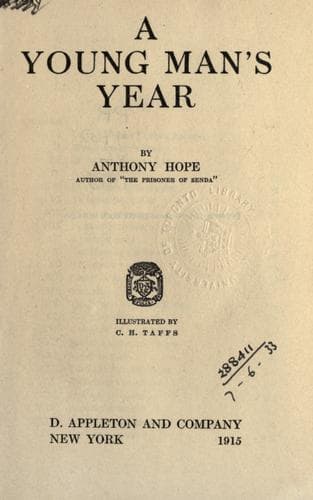
England -- Social life and customs -- Fiction; Lawyers -- Fiction; Man-woman relationships -- Fiction; Young men -- Fiction
"But who are they? Do you know them, Henry?"
"No, sir, I never heard of them. They're not clients of Mr. Norton
Ward's. But Mr. Mayne seemed to know about you. A shortish gentleman,
grey and rather bald--one of his eyelids sort o' trembles, something
like as if he was winking."
"Hum!" He did not identify the stranger. "How the deuce did they ever
hear of me?" Because although Arthur might have been cutting a figure in
society, and certainly was a person to whom notable things of a romantic
order had been happening, he was, as a member of the Bar, very young and
monstrously insignificant. "Well, it beats me!" he confessed as he
untied the tape which fastened _Tiddes v. the Universal Omnibus Company,
Ltd._.
Mr. Tiddes, it appeared (for of course Arthur dashed at the brief and
read it without a moment's delay), had a grievance against the Universal
Omnibus Company, Ltd., in that they had restarted their 'bus while he
was still in process of alighting, thereby causing him to fall in the
roadway, to sprain his thumb, bark his knee, and tear his trousers, in
respect of which wrongs and lesions he claimed forty pounds in damages.
The Omnibus Company said--well, according to their solicitors, Messrs.
Wills and Mayne, they did not seem to have very much to say. They
observed that their clients were much exposed to actions of this sort
and made it their policy to defend them whenever possible. The incident,
or accident, occurred late on Saturday night; Mr. Tiddes had been in
company with a lady (whom he left in the 'bus), and had struck the
conductor as being very animated in his demeanour. Counsel would make
such use of these facts as his discretion dictated. In short, a
knowledge of our national habits made falling off a 'bus late on
Saturday night in itself a suspicious circumstance. Add the lady, and
you added suspicion also. Add an animated demeanour, and the line of
cross-examination was clearly indicated to counsel for the defendants.
Not a clerk but Mr. Mayne himself met Arthur at the court; he was
recognisable at once by the tremor of his eyelid--like a tiny wink, a
recurring decimal of a wink. He was, it seemed, rather pessimistic; he
said it was a class of case that the Company must fight--"Better lose
than not defend"--and Mr. Lisle must do his best. Of course the
jury--and plaintiff had naturally elected to have a jury--would find
against the Company if they could; however Mr. Lisle must do his best.
Arthur said he would. He longed to ask Mr. Mayne how the deuce the firm
had ever heard of him, but judiciously refrained from thus emphasising
his own obscurity. Also he strove not to look frightened.
Public-domain text, read in full here on John Shaqi.
Reviews
Reviews
No reviews yet
Be the first to share your thoughts on this work.
Elsewhere in the archive
Join the Discussion
Join the discussion
Sign in to leave a comment or review.
Sign InorCreate an account