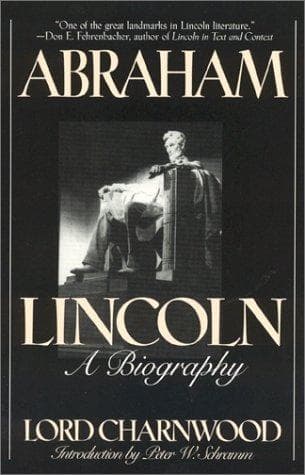
Abraham LincolnCharnwood, Godfrey Rathbone Benson, Baron
History
Abraham Lincoln
Charnwood, Godfrey Rathbone Benson, Baron
Lincoln, Abraham, 1809-1865; Presidents -- United States -- Biography
"You inquire where I now stand. That is a disputed point. I think I
am a Whig; but others say there are no Whigs, and that I am an
Abolitionist. When I was at Washington I voted for the Wilmot Proviso
as good as forty times; and I never heard of any one attempting to
un-Whig me for that. I now do no more than oppose the extension of
slavery. I am not a Know-Nothing, that is certain. How could I be?
How can any one who abhors the oppression of negroes be in favour of
degrading classes of white people? Our progress in degeneracy appears
to me pretty rapid. As a nation we began by declaring that 'all men
are created equal.' We now practically read it, 'all men are created
equal, except negroes.' When the Know-Nothings get control, it will
read, 'all men are created equal, except negroes and foreigners and
Catholics.' When it comes to this, I shall prefer emigrating to some
country where they make no pretence of loving liberty--to Russia, for
instance, where despotism can be taken pure, and without the base alloy
of hypocrisy.
"Mary will probably pass a day or two in Louisville in October. My
kindest regards to Mrs. Speed. On the leading subject of this letter I
have more of her sympathy than I have of yours; and yet let me say I am
"Your friend forever,
"A. LINCOLN."
The shade of doubt which this letter suggests related really to the
composition of political parties and the grouping of political forces,
not in the least to the principles by which Lincoln's own actions would
be guided. He has himself recorded that the repeal of the Missouri
Compromise meant for him the sudden revival in a far stronger form of
his interest in politics, and, we may add, of his political ambition.
The opinions which he cherished most deeply demanded no longer patience
but vehement action. The faculties of political organisation and of
popular debate, of which he enjoyed the exercise, could now be used for
a purpose which satisfied his understanding and his heart.
From 1854 onwards we find Lincoln almost incessantly occupied, at
conventions, at public meetings, in correspondence, in secret
consultation with those who looked to him for counsel, for the one
object of strengthening the new Republican movement in his own State of
Illinois, and, so far as opportunity offered, in the neighbouring
States. Some of the best of his reported and the most effective of his
unreported speeches were delivered between 1854 and 1858. Yet as large
a part of his work in these years was done quietly in the background,
and it continued to be his fate to be called upon to efface himself.
Public-domain text, read in full here on John Shaqi.
Reviews
Reviews
No reviews yet
Be the first to share your thoughts on this work.
Elsewhere in the archive
Join the Discussion
Join the discussion
Sign in to leave a comment or review.
Sign InorCreate an account