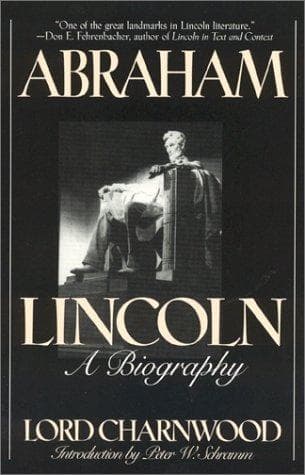
Abraham LincolnCharnwood, Godfrey Rathbone Benson, Baron
History
Abraham Lincoln
Charnwood, Godfrey Rathbone Benson, Baron
Lincoln, Abraham, 1809-1865; Presidents -- United States -- Biography
We can best understand the causes which suddenly made him a man of
national consequence by a somewhat close examination of the principles
and the spirit which governed all his public activity from the moment
of the repeal of the Missouri Compromise. The new Republican party
which then began to form itself stood for what might seem a simple
creed; slavery must be tolerated where it existed because the
Constitution and the maintenance of the Union required it, but it must
not be allowed to extend beyond its present limits because it was
fundamentally wrong. This was what most Whigs and many Democrats in
the North had always held, but the formulation of it as the platform of
a party, and a party which must draw its members almost entirely from
the North, was bound to raise in an acute form questions on which very
few men had searched their hearts. Men who hated slavery were likely
to falter and find excuses for yielding when confronted with the danger
to the Union which would arise. Men who loved the Union might in the
last resort be ready to sacrifice it if they could thereby be rid of
complicity with slavery, or might be unwilling to maintain it at the
cost of fratricidal war. The stress of conflicting emotions and the
complications of the political situation were certain to try to the
uttermost the faith of any Republican who was not very sure just how
much he cared for the Union and how much for freedom, and what loyalty
to either principle involved. It was the distinction of Lincoln--a man
lacking in much of the knowledge which statesmen are supposed to
possess, and capable of blundering and hesitation about details--first,
that upon questions like these he was free from ambiguity of thought or
faltering of will, and further, that upon his difficult path, amid
bewildering and terrifying circumstances, he was able to take with him
the minds of very many very ordinary men.
In a slightly conventional memorial oration upon Clay, Lincoln had said
of him that "he loved his country, partly because it was his own
country, and mostly because it was a free country." He might truly
have said the like of himself. To him the national unity of America,
with the Constitution which symbolised it, was the subject of pride and
of devotion just in so far as it had embodied and could hereafter more
fully embody certain principles of permanent value to mankind. On this
he fully knew his own inner mind. For the preservation of an America
which he could value more, say, than men value the Argentine Republic,
he was to show himself better prepared than any other man to pay any
possible price. But he definitely refused to preserve the Union by
what in his estimation would have been the real surrender of the
principles which had made Americans a distinct and self-respecting
nation.
Public-domain text, read in full here on John Shaqi.
Reviews
Reviews
No reviews yet
Be the first to share your thoughts on this work.
Elsewhere in the archive
Join the Discussion
Join the discussion
Sign in to leave a comment or review.
Sign InorCreate an account